OpenAI Releases Lockdown Mode to Secure Enterprise AI Workflows
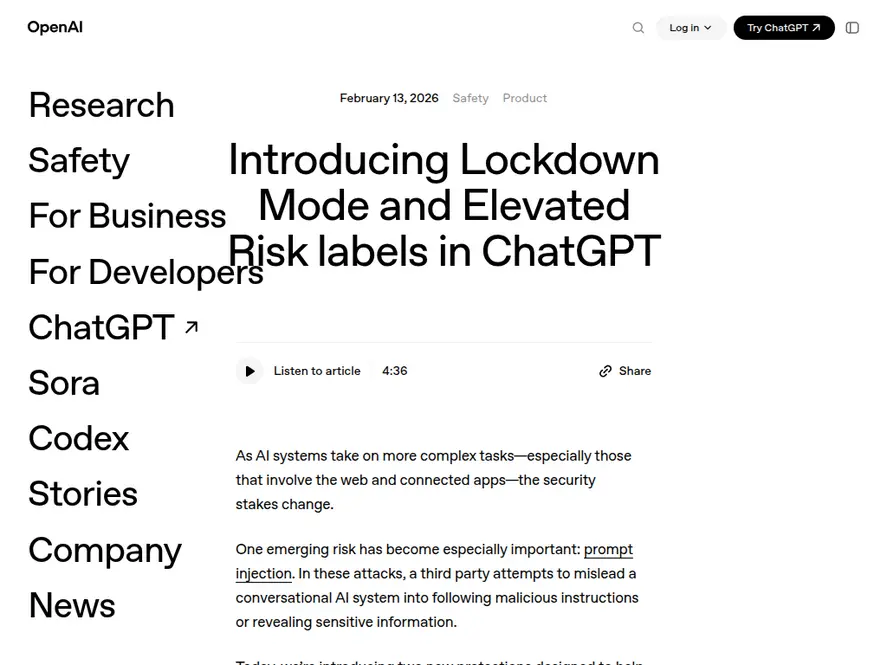
Security remains one of the primary hurdles for organizations integrating Large Language Models into their internal workflows. As AI agents gain the ability to browse the web and execute code, the surface area for attacks widens. On February 13, 2026, OpenAI introduced two significant security features designed to address these vulnerabilities: Lockdown Mode and standardized Elevated Risk labels. These new controls build upon the foundation established with the launch of the OpenAI Frontier platform, creating a more comprehensive security framework for enterprise deployments.
Addressing the Prompt Injection Threat
The core driver behind this update is the risk of prompt injection. In these scenarios, malicious actors attempt to manipulate an AI system into ignoring its safety protocols. This can lead to the model executing harmful instructions or inadvertently revealing sensitive data found in its connected apps or browsing history.
Lockdown Mode functions as a deterministic security layer. It goes beyond standard content filters by physically restricting what the model can do. When enabled, it disables specific tools and capabilities that are most susceptible to exploitation.
Key Technical Restrictions in Lockdown Mode
For developers and security engineers, it is important to understand exactly what breaks when this mode is active. The goal is to prevent data exfiltration, which often relies on the model forcing a connection to an external server controlled by an attacker.
The new mode enforces the following constraints:
- Restricted Web Browsing: The model cannot make live network requests to the open web. It is limited to cached content within OpenAI's controlled network environment.
- Disabled Features: Deep Research capabilities and other agentic behaviors that require autonomous decision making across multiple steps are turned off.
- File Security: While users can still upload files for analysis, the model is blocked from downloading files or generating file egress paths.
- Canvas Limitations: Users cannot approve code execution or network access within the Canvas interface.
Elevated Risk Labels for Developers
Alongside the restrictive Lockdown Mode, OpenAI is rolling out a transparency feature called "Elevated Risk" labels. These indicators will appear across ChatGPT, ChatGPT Atlas, and Codex.
For builders using Codex, this is particularly relevant. The release of GPT-5.3-Codex brought powerful agentic capabilities to developers, but these capabilities also introduce new security considerations. When a developer grants the coding assistant network access (for example, to look up live documentation), the interface will now clearly flag this as an "Elevated Risk" action. This standardizes how potential vulnerabilities are communicated, ensuring that users understand when an AI feature has left the safety of its sandbox to interact with untrusted external sources.
Availability and Implementation
Lockdown Mode is not intended for the average user but is designed for high value targets. This includes executives, security teams, and departments handling proprietary IP.
Currently, these features are available for:
- ChatGPT Enterprise
- ChatGPT Edu
- ChatGPT for Healthcare
- ChatGPT for Teachers
Administrators can enable Lockdown Mode via Workspace Settings by creating a specialized role. While this adds a heavy layer of restriction, Workspace Admins retain granular control over which specific applications are available to users, ensuring that critical business workflows are not completely severed.
OpenAI has stated that they plan to bring Lockdown Mode to consumer plans in the coming months. As the industry moves toward more autonomous AI agents, these "hard stop" security controls will likely become a standard requirement for deployment in sensitive environments.
Discover More AI Innovation
As AI security continues to evolve, staying informed about the latest tools and platforms is essential for developers and enterprise teams alike. Discover more cutting-edge AI tools and applications on Appse, your go-to directory for the latest AI innovations across security, development, and enterprise automation.
Source: Introducing Lockdown Mode and elevated risk labels in ChatGPT