Anthropic Launches Claude Code Security: A New AI Defense Layer for Builders
Anthropic introduces an AI-powered security scanner capable of reasoning through complex codebases to identify logic flaws that traditional tools miss.
Security in software development has long been a game of catch-up. For years, developers have relied on static analysis tools to catch bugs before they hit production. While effective for simple pattern matching, these tools often fail to spot the subtle, context-heavy vulnerabilities that lead to major breaches.
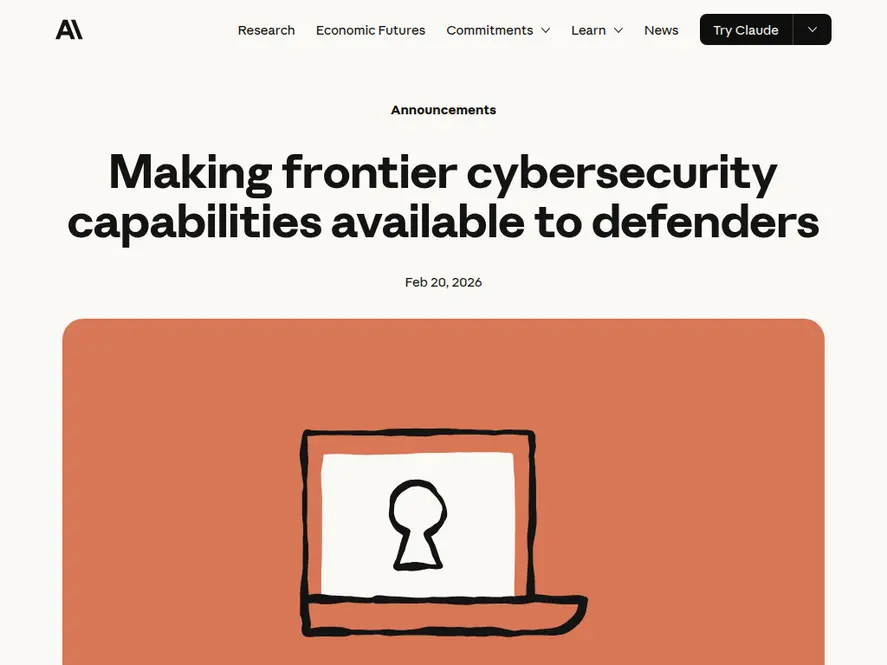
On February 20, 2026, Anthropic announced Claude Code Security, a specialized capability integrated into Claude Code on the web. Currently in a limited research preview, this tool is designed to help engineering teams and open-source maintainers detect high-severity vulnerabilities and fix them with AI-suggested patches.
Beyond Rule-Based Static Analysis
Most developers are familiar with the noise generated by standard security scanners. Traditional Static Application Security Testing (SAST) typically relies on predefined rules. It is excellent at catching outdated encryption methods or hardcoded credentials but struggles with business logic.
Claude Code Security takes a different approach. Instead of simply matching code against a database of known bad patterns, it uses the reasoning capabilities of the recently released Claude Opus 4.6 model. It analyzes how data flows through an application, understanding the interaction between different components to identify complex flaws like broken access controls or race conditions.
This shift from "pattern matching" to "reasoning" allows the tool to function more like a human security researcher. It reads the code, builds a mental model of the system architecture, and hypothesizes where logic might break down.
Key Features for Developers
For teams drowning in security backlogs, accuracy is more valuable than volume. Anthropic has built several features specifically to address the "false positive fatigue" that plagues developer security tools:
- Multi-Stage Verification: Before alerting a developer, the system attempts to disprove its own findings. It re-examines the code to verify if the vulnerability is actually exploitable, significantly reducing noise.
- Context-Aware Patching: The tool doesn't just flag issues; it suggests targeted code fixes. These suggestions take into account the surrounding code style and logic.
- Human-in-the-Loop Workflow: No code is changed automatically. The system provides a confidence rating and a suggested fix, but the developer retains full control to review, edit, and approve the patch.
- Prioritized Severity: Findings are ranked by severity, allowing teams to focus on critical infrastructure risks first.
Proving Ground: 500+ Zero-Day Vulnerabilities
The efficacy of this approach has already been tested in the wild. Anthropic's Frontier Red Team utilized the underlying technology, specifically the Claude Opus 4.6 model, to scan popular open-source repositories.
The results were significant. The team identified over 500 previously undetected vulnerabilities in production codebases. Many of these bugs had existed for years, bypassing expert human review and traditional automated tools. Anthropic is currently working with the respective maintainers to disclose and patch these issues responsibly.
Access and Availability
The launch represents a strategic move to arm defenders with the same AI capabilities that attackers might use. As AI models become better at finding exploits, the window between vulnerability discovery and exploitation shrinks.
Claude Code Security is available starting today as a limited research preview. Access is currently being rolled out to:
- Enterprise and Team customers
- Open-source maintainers (via an expedited free access program)
This rollout strategy focuses on high-impact codebases first, allowing Anthropic to refine the tool's capabilities in diverse, real-world engineering environments before a broader general release. Builders interested in stress-testing their security posture can apply for access directly through the Anthropic portal.
For teams working with open-source projects, Anthropic has also recently released Bloom, an open-source agentic framework for AI behavior evaluation, further demonstrating their commitment to building robust developer tools.
Discover more cutting-edge AI tools and apps on Appse, your go-to directory for the latest AI innovations in code security, development, and beyond.
Source: Anthropic - Claude Code Security