OpenAI has officially released GPT-5.3-Codex, marking a significant shift from simple code generation to fully autonomous "agentic" software engineering. Released on February 5, 2026, this new model represents the company's most capable coding agent to date, designed to handle the full spectrum of professional computer work.
For developers and founders, this update offers more than just smarter syntax suggestions. It introduces a system capable of long-running tasks, complex reasoning, and operating a computer environment with a level of proficiency that mirrors human interaction.
A Model That Helped Build Itself
One of the most striking aspects of GPT-5.3-Codex is its role in its own creation. OpenAI revealed that the Codex team utilized early versions of the model to debug the training process, manage deployment strategies, and analyze evaluation results.
This recursive development cycle highlights a major leap in utility. The model did not just generate code snippets; it acted as a functional engineer, accelerating the research team's velocity. It identified context rendering bugs, optimized infrastructure, and even dynamically scaled GPU clusters during high-traffic periods.
Key Technical Improvements
The architecture of GPT-5.3-Codex combines the frontier coding prowess of its predecessor, GPT-5.2-Codex, with the broader reasoning capabilities of GPT-5.2. This synthesis has resulted in several tangible benefits for builders:
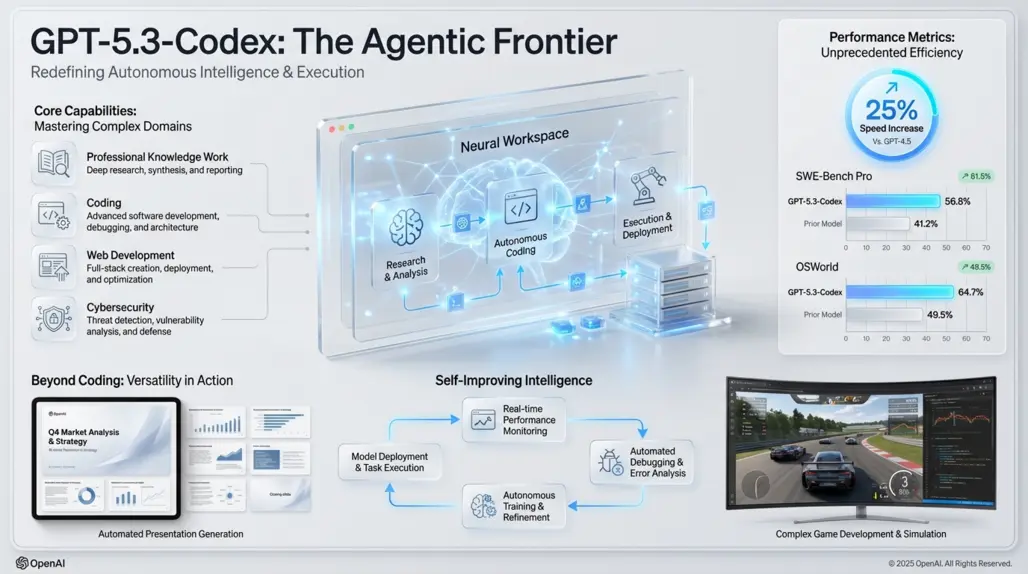
- 25% Faster Performance: Thanks to improvements in the inference stack and infrastructure (utilizing NVIDIA GB200 NVL72 systems), the model executes tasks significantly faster.
- State-of-the-Art Benchmarking: The model set new records on SWE-Bench Pro, a rigorous multi-language evaluation that mirrors real-world software engineering, and Terminal-Bench 2.0.
- Token Efficiency: It achieves these results using fewer tokens than prior models, allowing users to build more complex applications within the same constraints.
Beyond Code: True Computer Use
While previous iterations focused heavily on text-based code generation, GPT-5.3-Codex excels at "computer use"—the ability to navigate operating systems and execute tasks across different applications, a hallmark of advanced AI agents.
In the OSWorld-Verified benchmark, which tests an agent's ability to perform productivity tasks in a visual desktop environment, the model scored 64.7%. This is a massive jump compared to the roughly 38% scores of previous GPT-5.2 models. This capability allows the model to act as a general-purpose collaborator that can handle workflows involving terminal operations, file management, and web browsing seamlessly.
Web Development and Design
For frontend developers, the model demonstrates an improved "aesthetic sense." In testing, it autonomously built complex web games, including a racing game and a diving simulation, over the course of several days. It managed to iterate on these projects through vague prompts like "improve the game" or "fix the bug," handling the logic, design, and deployment nuances without needing constant hand-holding.
When tasked with building landing pages, the model now defaults to production-ready decisions. For example, it automatically formats pricing plans logically and creates dynamic UI components like testimonial carousels, understanding the intent behind underspecified prompts.
Security and Availability
With great power comes the need for robust security. OpenAI has classified GPT-5.3-Codex as "High capability" for cybersecurity tasks. It is the first model explicitly trained to identify software vulnerabilities. To mitigate risks, OpenAI has deployed a comprehensive safety stack, including the "Trusted Access for Cyber" program, which aids defenders in identifying exploits while preventing misuse.
The model is currently available to users on paid ChatGPT plans across the Codex app, CLI, and IDE extensions. API access is expected to roll out in the near future, allowing developers to integrate these agentic capabilities directly into their own applications.
The Future of Agentic Development
GPT-5.3-Codex represents a fundamental shift in how we think about AI-assisted development. Rather than simply suggesting the next line of code, it operates as a true collaborator capable of understanding intent, managing complexity, and executing multi-step workflows autonomously. As this technology continues to mature, the boundaries between human developers and AI agents will become increasingly collaborative rather than competitive.
Discover more cutting-edge AI tools and autonomous development platforms on Appse, your go-to directory for the latest innovations in AI-powered software engineering.
Source: Introducing GPT-5.3-Codex