OpenAI Frontier Launches: A Unified Platform for Enterprise AI Agents
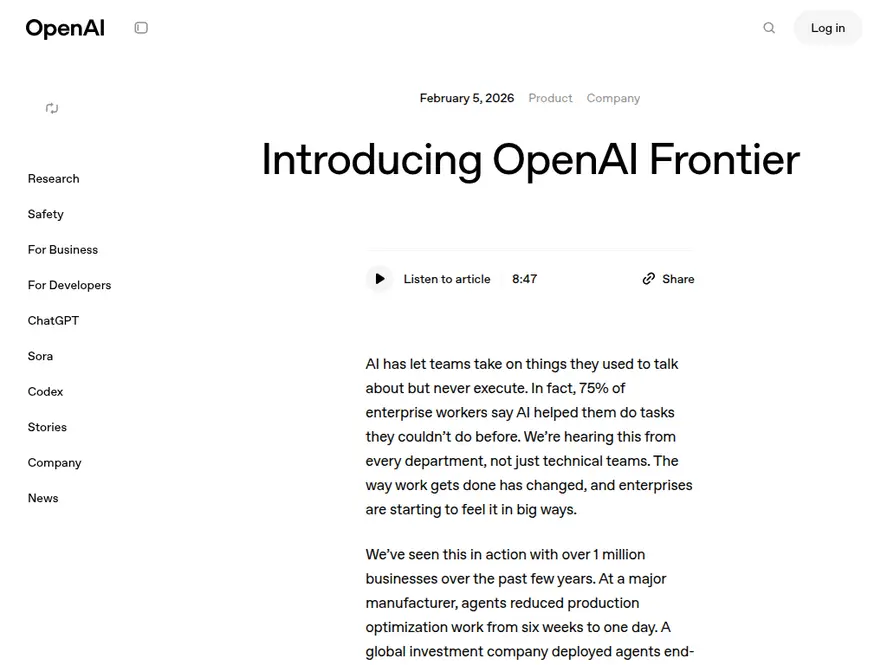
OpenAI has officially introduced Frontier, a new platform designed to bridge the widening gap between model intelligence and production deployment. Announced in February 2026, this release marks a significant shift from conversational AI to actionable "AI coworkers" capable of executing complex tasks within enterprise environments.
For builders and technical founders, Frontier addresses the most persistent challenge in the current AI landscape: the difficulty of orchestrating agents that have both the context to understand business logic and the permission to act on it securely. This platform represents OpenAI's strategic focus on closing the capability overhang, moving beyond raw model power to practical deployment solutions.
The Engineering Challenge: Moving Beyond Chat
While adoption of tools like ChatGPT has been rapid, integrating autonomous agents into core business processes has proven difficult for engineering teams. The primary bottleneck is not the model's capability but the fragmentation of data and governance.
Developers often find themselves building custom integrations for every new agent, struggling to provide enough context without compromising security. This results in isolated "toy" agents that cannot interact meaningfully with other systems. Frontier aims to solve this by providing a standardized infrastructure for building, deploying, and managing agents at scale.
Core Architecture for Developers
Frontier is built on open standards, allowing software teams to integrate it without replatforming their existing stacks. It operates as a semantic layer that connects siloed data warehouses, CRMs, and internal APIs.
Here is how the platform structures agent deployment:
- Unified Business Context: Agents access a shared understanding of how the organization operates. Instead of hard coding context for every single app, Frontier connects to existing systems to create a consistent knowledge base.
- Secure Execution Environment: The platform provides a runtime where agents can reason over data, run code, and utilize tools. This moves execution from a black box to a dependable environment that prioritizes low latency access to OpenAI models.
- Identity and Governance: Security is handled through explicit agent identities. Developers can define clear boundaries and permissions, ensuring an agent only accesses what it needs. This is critical for meeting compliance standards like SOC 2 in regulated industries.
- Feedback Loops: The system includes built in evaluation tools. This allows engineering managers to monitor agent performance and optimize behavior over time, similar to how human performance is managed.
Real World Impact on Workflows
The platform is already being piloted by major global enterprises, including State Farm, Oracle, and HP. The focus is on tangible operational improvements rather than just content generation.
For example, internal case studies highlighted a debugging workflow where engineers typically spent hours identifying root causes for hardware test failures. By deploying agents via Frontier that could parse logs, documentation, and code simultaneously, the team reduced identification time from four hours to just a few minutes. This type of implementation, powered by recent breakthroughs in agentic engineering models, demonstrates the platform's potential for DevOps and internal tooling.
The Partner Ecosystem and FDEs
To support complex deployments, OpenAI is pairing the platform with Forward Deployed Engineers (FDEs). These engineers work alongside customer teams to establish best practices, creating a direct feedback loop between enterprise needs and OpenAI research.
Additionally, an ecosystem of "Frontier Partners" has been established, featuring AI native builders like Abridge, Clay, and Harvey. These partners are building specialized agents on top of the Frontier standards, ensuring that third party tools can share the same context and governance controls as internal agents.
What This Means for Builders
The launch of Frontier suggests that the future of AI development is moving away from standalone model wrappers and toward integrated agent orchestration. For developers, the focus will shift from prompt engineering to system design, where the goal is defining the permissions, context, and tools that allow an agent to operate autonomously.
Frontier is currently available to a limited set of customers, with broader availability planned for later in 2026. Developers looking to prepare should focus on consolidating their data sources and defining clear API boundaries that future agents can utilize.
Discover more cutting-edge AI tools and platforms on Appse, your go-to directory for the latest AI innovations and autonomous agent solutions.
Source: Introducing OpenAI Frontier