GLM-5 Launches: A Massive Leap from Vibe Coding to Agentic Engineering
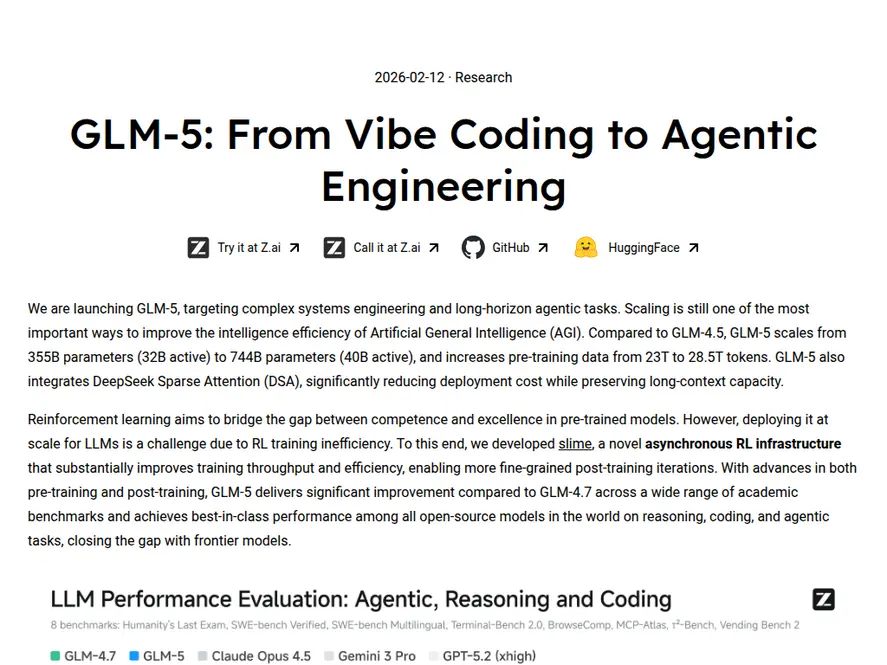
The landscape of open-source artificial intelligence has just shifted significantly with Z.ai (Zhipu AI) releasing GLM-5, a flagship model designed to move beyond simple chat interactions into the realm of complex systems engineering. While previous generations focused on competence, GLM-5 targets "excellence" in long-horizon tasks, positioning itself as a top-tier choice for developers building autonomous agents and sophisticated coding workflows.
Overview: Scaling for Intelligence
The transition from GLM-4.5 to GLM-5 represents a substantial jump in architectural scale and data density. The new model scales up to 744 billion parameters (with 40 billion active parameters per inference), trained on a massive corpus of 28.5 trillion tokens.
To manage this scale efficiently, the architecture integrates DeepSeek Sparse Attention (DSA). This technical addition allows the model to maintain a massive context capacity while significantly reducing deployment costs, addressing one of the primary bottlenecks in running large-scale Mixture-of-Experts (MoE) models.
Key Technical Innovations
Asynchronous RL Infrastructure ("Slime")
One of the most interesting revelations for machine learning engineers is the introduction of Slime, a novel asynchronous Reinforcement Learning (RL) infrastructure.
Refining pre-trained models via RL is standard, but doing so at scale is notoriously inefficient. Z.ai developed Slime to improve training throughput, enabling fine-grained post-training iterations. This infrastructure bridges the gap between a model that simply "knows" facts and one that can execute complex reasoning chains reliable.
Hardware Agnostic Deployment
In a move that diversifies the hardware ecosystem, GLM-5 is optimized for deployment across various compute architectures. Beyond standard NVIDIA support, it utilizes kernel optimization and model quantization to run effectively on chips including:
- Huawei Ascend
- Moore Threads
- Cambricon
- MetaX and Enflame
Agentic Engineering: Beyond "Chat"
The defining feature of GLM-5 is its focus on Agentic Engineering. Unlike "vibe coding" where a developer relies on an LLM for snippets and intuition, agentic engineering involves rigorous, multi-step execution where the model acts as an autonomous engineer.
Dominating Long-Horizon Tasks
The model's capability is best illustrated by its performance on Vending Bench 2, a benchmark requiring the model to manage a simulated vending machine business over a one-year horizon.
- GLM-5 Performance: Finished with a final account balance of $4,432.
- Comparison: This significantly outperforms other open-source models (some of which ended with ~$1,000) and narrows the gap with proprietary frontier models like Claude Opus 4.5.
This demonstrates strong long-term planning, resource management, and the ability to maintain coherent goals over extended interactions.
End-to-End Office Workflows
GLM-5 is not just for code; it is built for knowledge work. It can natively generate complex file formats, turning a prompt directly into ready-to-use .docx, .pdf, and .xlsx files. This allows agents to produce tangible deliverables like financial reports, PRDs, and lesson plans without human formatting intervention.
Benchmark Performance
Across academic and practical benchmarks, GLM-5 claims the top spot among open-source models for reasoning and coding.
- Reasoning: On Humanity's Last Exam (with tools), it scored 50.4, surpassing comparable open weights.
- Coding: Achieved 77.8 on SWE-bench Verified, making it a robust engine for autonomous software engineering.
- Math: Scored 92.7 on AIME 2026 I, demonstrating high-level mathematical problem-solving.
Impact for Developers and Builders
For founders and engineers, GLM-5 offers a high-performance, open-weights alternative to proprietary APIs, with specific integrations ready for immediate use.
- Direct Integration: The model is compatible with agent frameworks like Claude Code and OpenClaw, allowing it to operate across apps and devices.
- Licensing: Weights are released under the MIT License, providing maximum freedom for commercial innovation.
- Local & API Access: Available via Hugging Face for local hosting and through the Z.ai API for managed inference.
By combining massive scale, efficient attention mechanisms, and a focus on long-context agentic behaviors, GLM-5 sets a new standard for what builders can expect from open-source foundation models in 2026.
Discover more cutting-edge AI tools and explore the latest innovations in artificial intelligence on Appse, your comprehensive directory for AI apps, agents, and open-source models shaping the future of technology.
Source: GLM-5 Launch Announcement