
DeepSeek's Silent FlashMLA Reveal: The Power Behind the Industry Debate
New open-source attention kernels drive DeepSeek-V3 performance, offering developers unprecedented efficiency on H800 and B200 GPUs.
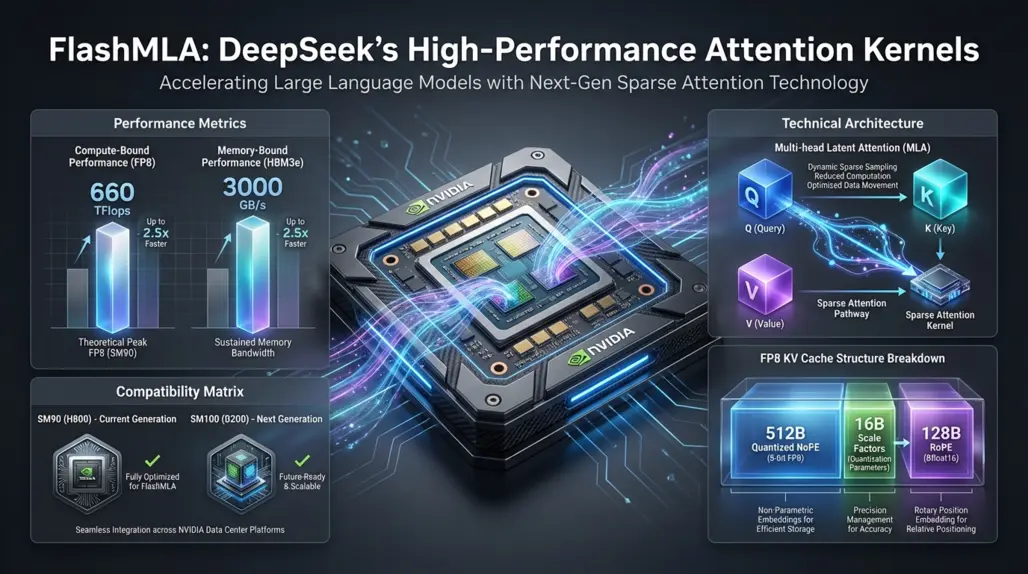
In a move that has sparked conversation across the AI infrastructure landscape, DeepSeek has quietly unveiled FlashMLA, a high-performance library of optimized attention kernels. While the industry buzz—often referred to as the "MODEL1" debate—has focused on the capabilities of next-generation models, the release of FlashMLA provides the concrete technical foundation that makes these advancements possible.
This release offers builders and engineers a look under the hood of DeepSeek-V3 and DeepSeek-V3.2, revealing how the company is squeezing massive efficiency gains out of existing hardware constraints.
The Engine Behind DeepSeek-V3
FlashMLA is designed to tackle the most computationally expensive part of Large Language Model (LLM) inference: the attention mechanism. By open-sourcing these kernels, DeepSeek is democratizing access to the specific optimizations used in their proprietary Multi-head Latent Attention (MLA) architecture, contributing significantly to the growing landscape of open source AI projects.
The library specifically targets NVIDIA's Hopper (SM90) and the upcoming Blackwell (SM100) architectures, providing a roadmap for developers looking to maximize throughput on top-tier GPUs.
Key Technical Capabilities
The release introduces two primary categories of kernels, each optimized for different stages of the generation pipeline:
- Sparse Attention Kernels: Designed for DeepSeek Sparse Attention (DSA), these kernels manage token-level sparsity. They are critical for the prefill stage and the decoding stage, utilizing an FP8 KV cache to significantly reduce memory footprint without sacrificing speed.
- Dense Attention Kernels: These handle standard dense attention operations for both prefill and decoding, ensuring robust performance across varied workloads.
Breaking the Speed Limit: 660 TFLOPS
For developers focused on raw performance, the benchmarks released with FlashMLA are turning heads. The optimization work is specifically tailored for the H800 SXM5 GPU (a variant of the H100 widely used in restricted markets) and the cutting-edge B200.
Benchmarks reveal impressive throughput figures:
- Decoding Performance: The dense MLA decoding kernel hits up to 3000 GB/s in memory-bound configurations. In compute-bound scenarios, it achieves a staggering 660 TFLOPS on the H800 SXM5.
- Sparse Efficiency: The token-level sparse decoding kernel, leveraging BF16 matrix multiplication with an FP8 KV cache, maintains 410 TFLOPS on the H800.
- Future-Ready on B200: Preliminary tests on NVIDIA's B200 architecture show the sparse prefill kernels reaching up to 1450 TFLOPS, signaling massive headroom for future model scaling.
Impact for Developers and Founders
The "silent" nature of this reveal belies its impact. For AI founders and infrastructure engineers, FlashMLA solves several critical pain points, particularly as recent findings on the surging compute demands of power users continue to reshape infrastructure requirements:
- Memory Optimization: The native support for FP8 KV Caching allows builders to fit larger context windows or larger batch sizes into GPU memory. The library handles the complex quantization (separating high-precision RoPE parts from quantized NoPE parts) automatically.
- Hardware Agnostic Ambitions: While NVIDIA remains the primary target, the repository indicates broad community support for alternative hardware, including AMD Instinct, Moore Threads, and Hygon DCU. This suggests a push towards a more universal standard for high-performance attention kernels.
- Drop-in Upgrades: DeepSeek claims the new kernels are interface-compatible with previous versions, offering an immediate 5% to 15% performance boost for compute-bound workloads simply by upgrading—a significant advantage for teams building with AI developer tools.
What This Means for the Industry
The release of FlashMLA shifts the conversation from theoretical model capabilities to practical engineering solutions. By optimizing for the H800 and B200 specifically, DeepSeek is demonstrating how software efficiency can bridge the gap created by hardware availability challenges, complementing NVIDIA's longer-term roadmap for lowering inference costs through next-generation platforms.
For the developer community, the debate isn't just about how smart the model is—it's about how efficiently it can run. With FlashMLA, DeepSeek has provided a powerful answer.
Discover more cutting-edge AI tools and innovations on Appse, your comprehensive directory for the latest AI applications and developer resources.