Overview
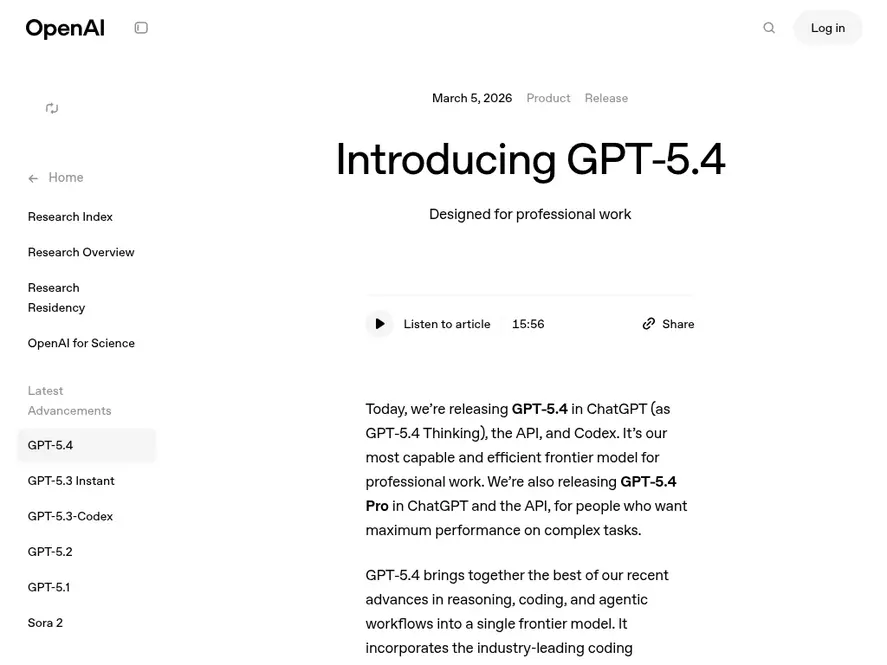
OpenAI has officially released GPT-5.4 and GPT-5.4 Pro, marking a significant shift in how developers will build AI agents moving forward. Launched on March 5, 2026, this model family is not just an iteration of text generation but a fundamental upgrade in how models interact with software environments. By merging the coding proficiency of GPT-5.3-Codex with advanced reasoning, GPT-5.4 aims to be the standard for professional agentic workflows.
For builders and founders, the headline feature is native computer use. This allows the model to navigate desktop environments, interpret screenshots, and execute mouse and keyboard commands, effectively bridging the gap between text-based reasoning and functional software operation.
Key Features for Developers
GPT-5.4 introduces several architectural improvements designed specifically to reduce friction in building complex agents.
- Native Computer Use: Unlike previous models that required complex wrappers to interact with UIs, GPT-5.4 has state-of-the-art computer use capabilities built in. It achieves a 75.0% success rate on OSWorld-Verified benchmarks, allowing agents to navigate websites and software systems using coordinate-based interactions.
- 1M Token Context Window: The model supports up to 1 million tokens of context. This massive window allows agents to maintain state across long-horizon tasks, such as debugging a large codebase or managing an entire project lifecycle without losing thread.
- Dynamic Tool Search: This is a major efficiency update for the API. Instead of loading every possible tool definition into the context (which burns tokens and adds latency), the model now uses a lightweight list. It dynamically searches for and loads only the tool definitions it needs at the moment of execution.
- Steerable Reasoning: In the new "Thinking" mode, the model provides an upfront plan. Developers can intervene mid-process to adjust the course, reducing the need to restart expensive queries from scratch.
Performance and Benchmarks
The performance metrics suggest a focus on reliability over pure creative generation. On the GDPval benchmark, which simulates real-world knowledge work across 44 occupations, GPT-5.4 matched or exceeded human professionals 83.0% of the time. This is a substantial leap from the 70.9% score held by GPT-5.2.
In coding tasks, the model integrates the strengths of GPT-5.3-Codex but improves on speed and aesthetic output for frontend tasks. It also shows a significant reduction in hallucinations. Internal testing reveals that the model is 18% less likely to contain errors in full responses compared to its predecessor.
API and Pricing Implications
For founders calculating unit economics, GPT-5.4 comes with a price increase per token but a promise of higher efficiency. The input price is set at $2.50 per million tokens, with output at $15.00 per million tokens. However, the introduction of Tool Search means that complex agents with access to hundreds of tools will likely consume far fewer tokens per request, potentially balancing out the cost for heavy workloads.
OpenAI has also released a "Pro" variant in the API (gpt-5.4-pro) for tasks requiring maximum reasoning density, alongside the standard gpt-5.4. Both models are available immediately through conversational AI platforms like ChatGPT, with the legacy GPT-5.2 Thinking models slated for retirement in June 2026.
Impact on Agentic Workflows
The release of GPT-5.4 signals that OpenAI is aggressively targeting the "agent" market. The combination of high-fidelity visual perception (up to 10.24M pixels) and the ability to click and type means developers can now build bots that use software the way humans do. This capability is particularly valuable for AI web automation ecosystems and opens up new possibilities for automating legacy enterprise software that lacks proper APIs, as the model can simply look at the screen and operate the interface directly.
What This Means for Builders
GPT-5.4 represents a convergence of OpenAI's specialized models into a single, unified system capable of handling everything from complex reasoning to hands-on software interaction. For developers working in the AI Code & Dev space, this means fewer model switches, lower integration overhead, and more predictable behavior across diverse automation tasks.
The native computer use feature fundamentally changes what's possible with autonomous agents, enabling them to interact with any software interface without requiring API access or custom integrations. Combined with the extended context window and dynamic tool search, GPT-5.4 provides the infrastructure needed for truly autonomous, long-running agent workflows.
Discover more cutting-edge AI tools and autonomous systems on Appse, your comprehensive directory for the latest AI innovations and developer resources.
Source: Introducing GPT-5.4