Alibaba Cloud has officially released Qwen3-Max-Thinking, a new flagship reasoning model designed to compete directly with top-tier systems like GPT-5.2 and Claude-Opus-4.5. Unlike previous open-weight releases from the Qwen team, this model is available exclusively via API, signaling a shift toward high-performance, enterprise-grade managed services.
For developers and founders building complex agentic workflows, this release introduces significant advancements in test-time scaling and native tool integration.
A New Contender in Reasoning
Qwen3-Max-Thinking is built on a massive Mixture-of-Experts (MoE) architecture, reportedly exceeding 1 trillion parameters. However, raw size isn't the main headline. The model distinguishes itself through advanced test-time scaling capabilities.
Instead of generating a single response, the model allocates additional computation during the inference phase to "think" through complex problems. This approach allows it to tackle multi-step tasks in mathematics, coding, and planning with higher accuracy than standard large language models (LLMs).
The "Experience-Cumulative" Strategy
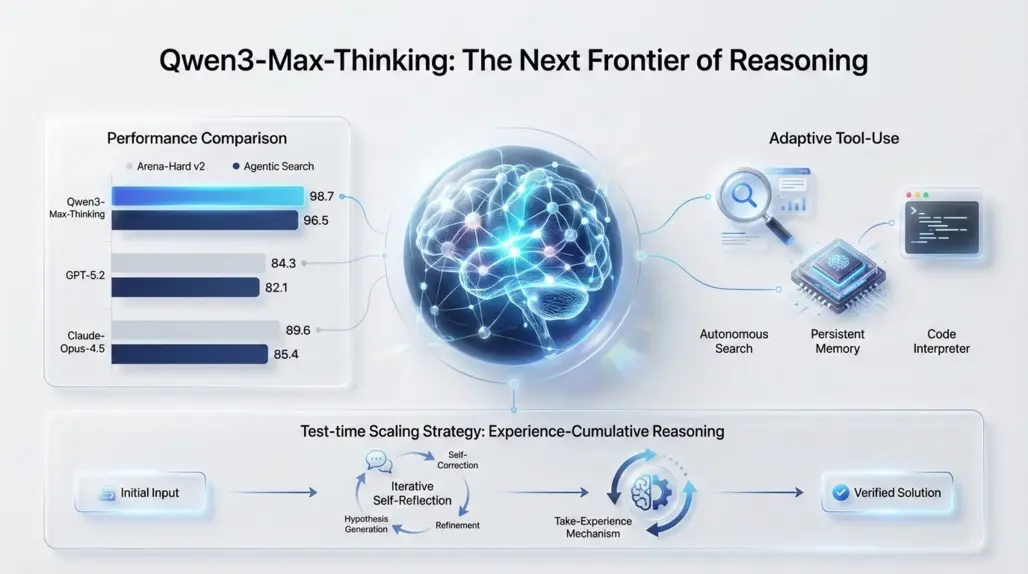
What makes this model unique for builders is its specific approach to scaling inference. Rather than simply generating parallel possibilities and picking the best one (which burns tokens efficiently), Qwen3-Max-Thinking uses an "experience-cumulative" strategy.
During its reasoning process, the model performs iterative self-reflection. It distills insights from previous reasoning steps to avoid repeating mistakes or re-deriving known facts. This results in higher context efficiency, allowing the model to solve harder problems without linearly increasing token consumption.
Native Adaptive Tool-Use
For engineers building autonomous agents, the model's Adaptive Tool-Use capability is a game-changer.
Most current implementations require developers to manually define tools and orchestrate when they are called. Qwen3-Max-Thinking autonomously selects and utilizes built-in capabilities during a conversation. These include:
- Code Interpreter: Executing Python snippets for computational logic.
- Search: Retrieving real-time information to reduce hallucinations.
- Memory: Maintaining long-term state across session turns.
The model has been trained to treat these tools as native extensions of its thought process, leading to smoother agentic behaviors compared to prompt-engineered tool calling.
Integration for Developers
The Qwen team has maintained high compatibility with existing developer workflows. The API supports both OpenAI and Anthropic protocols, meaning drop-in replacement is possible for many existing applications.
To activate the reasoning capabilities, developers simply need to pass an extra parameter in their API calls. For example, in a standard Python client setup, adding extra_body={"enable_thinking": True} unlocks the model's full reasoning potential. This works seamlessly with tools like Claude Code, allowing the model to function as a backend for complex coding assistants.
Benchmark Performance
In self-reported evaluations, Qwen3-Max-Thinking demonstrates impressive performance across major benchmarks:
- Coding: Scores 85.9 on LiveCodeBench v6, positioning it as a strong alternative for software engineering tasks.
- Math & Science: Outperforms Gemini 3 Pro on several STEM benchmarks, including GPQA.
- Agentic Search: Shows superior handling of tool-augmented tasks compared to Claude-Opus-4.5.
Access and Availability
Qwen3-Max-Thinking is currently available through Alibaba Cloud's Model Studio and the Qwen Chat platform. While the move to a closed-source API might disappoint fans of Qwen's open-weights history, the performance gains offered by the managed infrastructure present a compelling option for enterprise applications requiring high-reliability reasoning.
Discover more cutting-edge AI tools and intelligent reasoning systems on Appse, your go-to directory for the latest AI innovations and developer resources.