Qwen3-TTS Family Released: Open Source Voice Design, Cloning, and Control
Alibaba Cloud's Qwen team releases powerful 1.7B and 0.6B speech models with ultra-low latency and prompt-based voice creation capabilities.
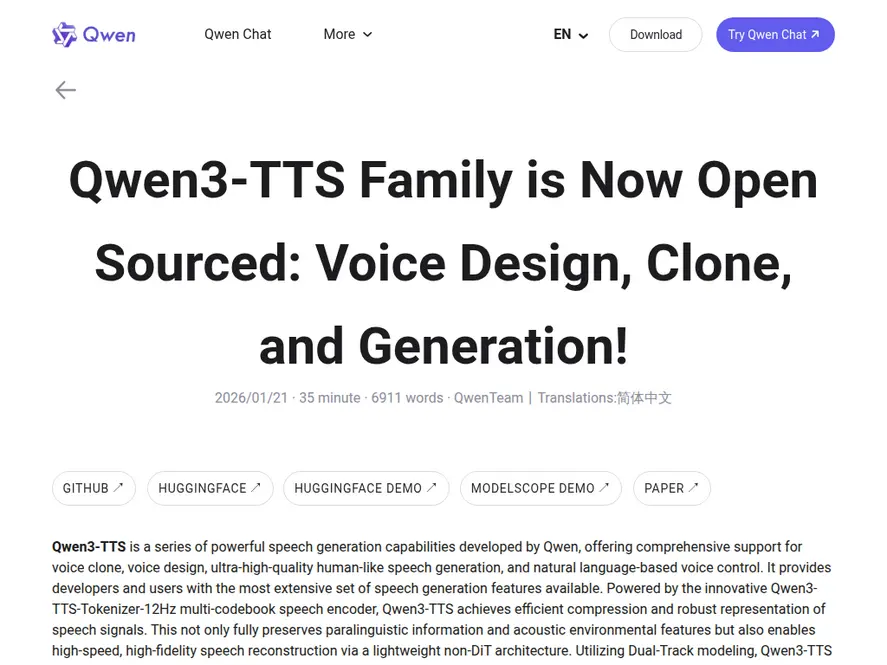
Qwen3-TTS Released: A New Era for Open-Source Voice Design and Cloning
The landscape of AI speech generation just shifted significantly with the Qwen team's latest release. Qwen3-TTS is now fully open-source, delivering a powerful suite of text-to-speech (TTS) capabilities that goes far beyond simple reading. For builders and developers, this family of models introduces high-fidelity voice cloning, natural language voice design, and granular instruction control, all under a permissive Apache 2.0 license.
Whether you are building real-time conversational agents or content creation tools, Qwen3-TTS offers a robust alternative to closed-source APIs, boasting state-of-the-art performance in latency and expressiveness. For developers seeking a complete agent solution, pairing Qwen3-TTS with Alibaba's recent MAI-UI framework for interface design creates a powerful end-to-end development stack.
Under the Hood: Architecture and Efficiency
At the core of this release is the innovative Qwen3-TTS-Tokenizer-12Hz. Unlike traditional models that struggle with the trade-off between compression and quality, this multi-codebook speech encoder achieves efficient compression while preserving crucial paralinguistic details: the subtle sighs, breaths, and tonal shifts that make speech sound human.
The system utilizes a Universal End-to-End Architecture. By adopting a discrete multi-codebook language model (LM) approach and bypassing the complex diffusion pipelines (non-DiT) often seen in recent TTS research, Qwen3-TTS reduces cascading errors and computational overhead.
For developers focused on real-time applications, the Dual-Track modeling is a standout feature. It allows for extreme bidirectional streaming, delivering the first audio packet after processing just a single character. With end-to-end latency as low as 97ms, it is primed for interactive voice bots where speed is critical.
Key Capabilities for Builders
The Qwen3-TTS family is designed to solve complex audio challenges out of the box.
- Prompt-Based Voice Design: You no longer need a reference audio file to create a speaker. Using the
VoiceDesignmodel, you can describe a persona in natural language (e.g., "A sarcastic teenage girl with a raspy voice") and the model generates a unique voice identity to match. - 3-Second Voice Cloning: For scenarios requiring specific voice replication, the
VoiceClonecapability can mimic a target speaker using only 3 seconds of reference audio. This works across languages, maintaining the speaker's timbre even when they speak a foreign tongue. - Granular Instruction Control: Treat audio generation like text prompting. You can instruct the model to change emotion, speed, pitch, and prosody dynamically. The model understands context, adapting its tone based on the semantics of the text.
- Multilingual Support: The models support 10 mainstream languages, including English, Chinese, Japanese, Korean, German, French, Russian, Portuguese, Spanish, and Italian, making it a globally viable solution.
Model Variants and Deployment
Qwen has released the family in two sizes to balance performance and resource constraints:
1.7B Models (Peak Performance)
- Qwen3-TTS-12Hz-1.7B-VoiceDesign: Optimized for creating new voices from descriptions.
- Qwen3-TTS-12Hz-1.7B-CustomVoice: Focuses on style control and fine-tuning target timbres.
- Qwen3-TTS-12Hz-1.7B-Base: The foundation for cloning and further fine-tuning.
0.6B Models (Efficiency)
- Ideal for edge deployments or cost-sensitive applications, offering a balance of quality and speed with the same 12Hz tokenizer efficiency.
Why This Matters
The release of Qwen3-TTS represents a democratization of "Voice Design." Previously, high-quality, instruction-following TTS was largely locked behind proprietary APIs like ElevenLabs or OpenAI. By open-sourcing these 1.7B and 0.6B models, Qwen provides founders and engineers the building blocks to create immersive audio experiences without recurring API costs or data privacy concerns.
This approach contrasts sharply with strategies for empowering builders employed by proprietary providers, who maintain control through managed APIs. Qwen's open-source philosophy puts the power directly in developers' hands, enabling customization and deployment flexibility that closed systems cannot match.
With its ability to handle complex instructions and maintain stability over long-form content, Qwen3-TTS is set to become a standard component in the open-source AI audio stack.
Explore More AI Innovation
Discover more cutting-edge AI tools and applications on Appse, your go-to directory for the latest innovations in artificial intelligence. Whether you're looking for audio solutions, development frameworks, or emerging technologies, Appse helps you find the right tools to power your next project.
Source: Qwen3-TTS Official Release