OpenAI Releases GPT-5.4: The New Standard for Autonomous AI Agents
Native computer use, massive context windows, and efficient tool search mark a significant leap forward for developers and professional builders.
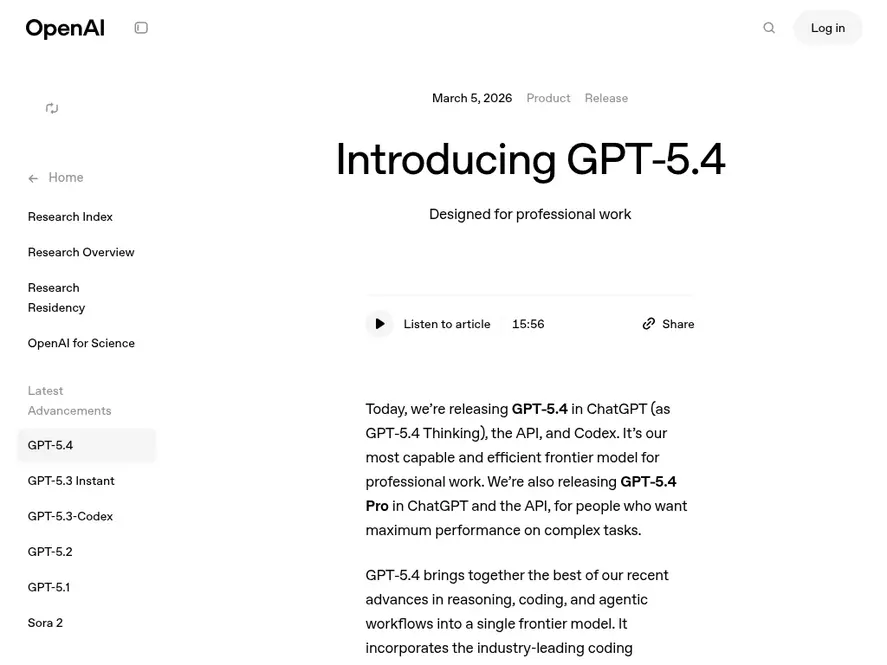
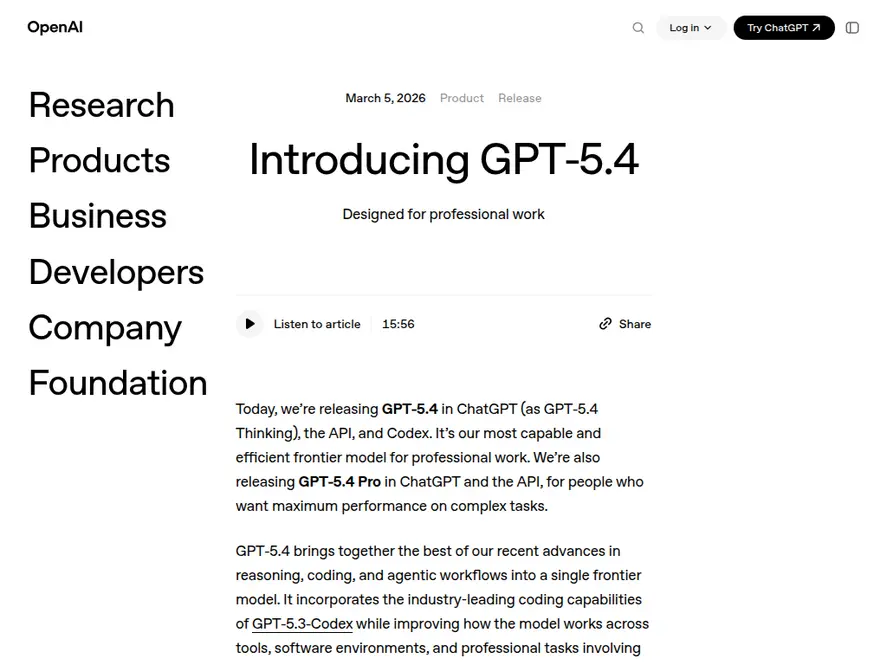
OpenAI has officially launched GPT-5.4, a frontier model designed specifically to handle the complexities of professional work and agentic workflows. Released on March 5, 2026, this update represents a strategic shift from simple chatbots to capable, autonomous AI agents that can plan, execute, and verify tasks across long horizons.
For founders and developers, GPT-5.4 is not just an incremental speed boost. It brings native computer-use capabilities and a massive 1 million token context window, enabling the creation of agents that can navigate software environments and manage expansive projects with a level of reliability previously unseen in the GPT series.
Native Computer Use: Agents That Act
The most significant advancement in GPT-5.4 is its native ability to operate computers. While previous models relied on text-based API calls to interact with the world, GPT-5.4 can interpret screenshots and issue keyboard and mouse commands. This allows it to navigate websites, use desktop applications, and execute workflows through standard user interfaces.
This capability is backed by impressive benchmarks. On OSWorld-Verified, a test measuring an AI's ability to navigate desktop environments, GPT-5.4 achieved a 75% success rate. This far exceeds the 47.3% score of GPT-5.2 and even surpasses human performance in specific tasks. For developers using frameworks like Playwright, this opens the door to building agents that can visually debug applications or automate complex legacy software tasks that lack clean APIs.
"Thinking" Models and Steerability
In ChatGPT, the model introduces a "Thinking" feature that displays its plan before generating a full response. This allows users to review the logic and adjust the course mid-stream if the model is heading in the wrong direction. For coding and architectural tasks, this reduces the frustrating back-and-forth often required to correct a hallucinating model.
This steerability extends to the API as well. The model is designed to maintain context over longer periods, making it highly effective for deep research or multi-step coding generation. It combines the specialized coding strengths of the recent GPT-5.3-Codex with broad general knowledge, resulting in a system that can handle ambiguous engineering problems with greater autonomy.
Optimized for Developer Efficiency
OpenAI has introduced several infrastructure improvements to support builders working with large-scale agentic systems.
- Tool Search: Previously, developers had to load every possible tool definition into the context window, which wasted tokens and money. GPT-5.4 introduces "tool search," allowing the model to dynamically look up and load only the tools it needs from a lightweight list. This reduces token usage by nearly 50% for tool-heavy applications.
- 1 Million Token Context: The model supports an experimental context window of up to 1 million tokens. This capacity allows agents to ingest entire codebases, massive documentation libraries, or long financial reports without losing coherence.
- Visual Fidelity: A new "original" image input detail level supports up to 10 megapixels. This high-fidelity vision is crucial for agents that need to read dense charts, analyze blueprints, or navigate complex software UIs.
Performance and Pricing
GPT-5.4 is priced as a premium model, reflecting its advanced capabilities. Input tokens are priced at $2.50 per million, with output tokens at $15 per million. While this is higher than GPT-5.2, OpenAI argues that the model's improved reasoning efficiency means it requires fewer steps and fewer tokens to solve complex problems, potentially lowering the total cost per task.
For those needing maximum power, a "Pro" variant is available, offering peak performance for the most demanding reasoning tasks. Conversely, for faster, lower-latency needs, the standard model includes a "fast" mode in Codex that increases token velocity by 1.5x, helping developers stay in flow during rapid iteration cycles.
What This Means for Builders
The release of GPT-5.4 signals that the industry is moving beyond chat interfaces toward autonomous action. The combination of high-accuracy tool calling, visual computer use, and massive context windows provides the necessary primitives for building true AI coworkers rather than just smart text generators.
Developers exploring these cutting-edge capabilities will find tremendous value in the broader ecosystem of AI coding assistants and developer tools that complement GPT-5.4's advanced features. Whether you're building autonomous agents, debugging complex systems, or architecting next-generation applications, the landscape of AI-powered development tools continues to expand rapidly.
Developers can access GPT-5.4 today via the API, with gradual rollouts continuing across ChatGPT and Codex environments.
Discover more cutting-edge AI tools and applications on Appse, your comprehensive directory for the latest AI innovations and autonomous systems.
Source: Introducing GPT-5.4