Kimi K2.5: A New Era of Visual Agentic Intelligence and Swarms
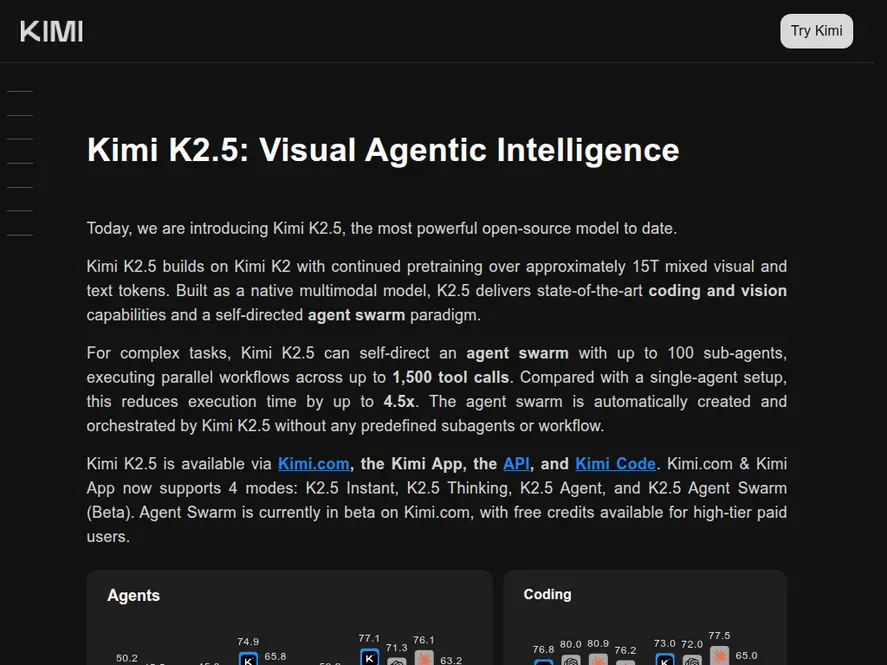
Moonshot AI has officially unveiled Kimi K2.5, a massive leap forward in open-source multimodal models. Built on a native Mixture-of-Experts (MoE) architecture, Kimi K2.5 introduces "Visual Agentic Intelligence," designed to handle complex coding tasks, visual reasoning, and autonomous multi-agent coordination with unprecedented efficiency.
For builders and founders, this release signals a shift from linear agent workflows to parallel, self-directed "swarms" capable of executing massive tasks at a fraction of the time.
Native Multimodal Powerhouse
Unlike models that rely on separate adapters for vision and text, Kimi K2.5 is natively multimodal. It was pre-trained on approximately 15 trillion mixed visual and text tokens. This foundational approach allows the model to reason across text, images, and video simultaneously without the performance degradation often seen in "bolted-on" multimodal systems.
Technical specifications reveal a robust architecture:
- Total Parameters: ~1 Trillion
- Active Parameters: ~32 Billion per inference (via MoE routing)
- Input Types: Text, Image, Video, and heavy Document/PDF ingestion
The Agent Swarm Paradigm
The most significant innovation for developers is the introduction of the Agent Swarm. While traditional agentic workflows operate sequentially (step-by-step), Kimi K2.5 can self-direct a swarm of up to 100 sub-agents.
This capability allows the model to:
- Parallel Execution: Decompose complex problems into parallel subtasks.
- Massive Tool Use: Coordinate up to 1,500 tool calls in a single session.
- Reduced Latency: Achieve up to a 4.5x reduction in execution time compared to single-agent setups.
This system is powered by Parallel-Agent Reinforcement Learning (PARL). The model utilizes a trainable orchestrator that dynamically instantiates "frozen" sub-agents for specialized tasks such as research, fact-checking, or coding without requiring hand-crafted workflows or predefined roles. This approach mirrors the philosophy behind multi-agent orchestration frameworks like CrewAI, which enable developers to design and manage coordinated agent crews for complex automation.
Visual Coding and Debugging
Kimi K2.5 significantly advances the frontier of AI-assisted engineering. The model excels at coding with vision, meaning it can translate visual inputs directly into functional code.
Key capabilities for software engineers include:
- Design to Code: Converting simple conversation and visual prompts into complete front-end interfaces with interactive layouts and rich animations. This capability aligns with recent developments in agent-to-UI workflows, where AI autonomously generates and manages user interfaces.
- Visual Debugging: Analyzing video or screenshots to identify bugs and autonomously iterating on the code to fix them. This autonomous debugging capability reflects a broader trend, with enterprises like Cisco redefining engineering with AI agents that autonomously repair code in production environments.
- Multimedia Reasoning: In complex logic tasks, such as solving a visual maze, the model demonstrates the ability to plan, write pathfinding algorithms (like BFS), and verify the solution visually.
In internal benchmarks, specifically the "Kimi Code Bench," K2.5 demonstrated consistent improvements in refactoring, testing, and scripting tasks over its predecessor.
Impact on Office Productivity
Beyond coding, Kimi K2.5 is engineered for high-density knowledge work. It addresses the "context window" challenge not just by accepting large inputs, but by effectively processing them.
The model can handle:
- Long-form Content: Drafting 10,000-word papers or analyzing 100-page documents.
- Complex Formatting: Constructing financial models with Pivot Tables, adding annotations to Word documents, and writing LaTeX equations in PDFs.
What This Means for Builders
The release of Kimi K2.5 as an open-source model provides developers with a powerful alternative to closed-source frontier models. Its ability to run locally or via API, combined with the efficiency of its MoE architecture, makes it a viable option for building complex, agentic applications that require heavy reasoning and multimodal inputs.
By moving from single-agent scaling to coordinated swarm intelligence, Kimi K2.5 offers a glimpse into the future of autonomous workflows where AI doesn't just assist with tasks but orchestrates entire projects.
Discover more cutting-edge AI tools and innovations on Appse, your go-to directory for exploring the latest AI agents, coding assistants, and autonomous systems shaping the future of development.
Source: Kimi K2.5 Official Announcement