A New Era for Autonomous Agents
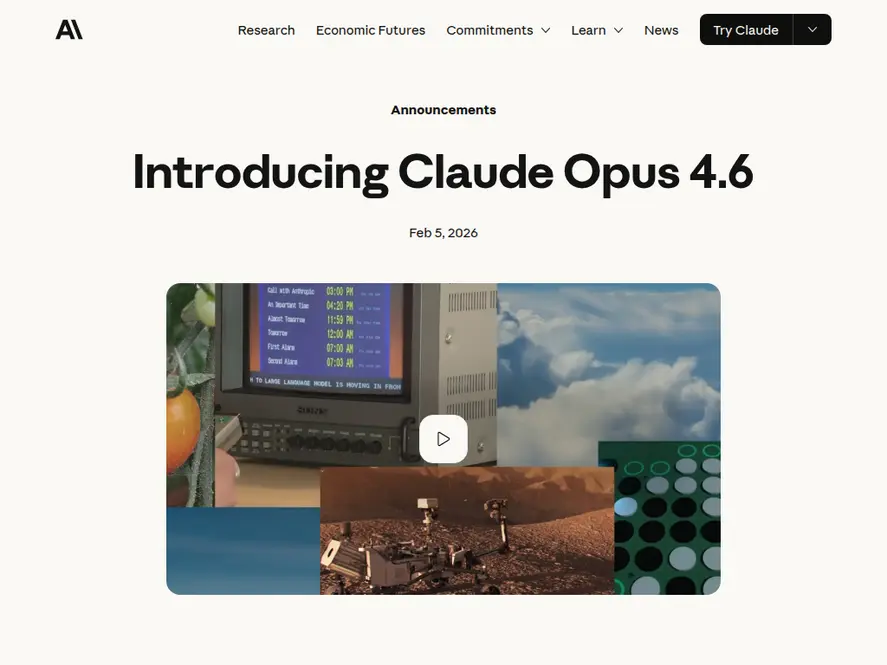
Anthropic has officially released Claude Opus 4.6, a model that signals a significant shift from simple chatbots to robust, autonomous agents. Released on February 5, 2026, this update focuses heavily on "agentic" capabilities, specifically the ability to plan, execute, and review complex tasks over long periods without constant human hand-holding. This strategic evolution builds upon Anthropic's recent work in agentic workflows and desktop integrations, positioning Claude as a full-fledged autonomous development partner.
For developers and founders building on top of LLMs, Opus 4.6 addresses the primary friction points of previous generations: context drift during long tasks, the inability to handle massive codebases reliability, and the lack of granular control over reasoning costs.
Redefining Agentic Coding
The standout feature for builders is the enhanced performance in software engineering. Opus 4.6 is designed to operate effectively within large repositories. Unlike previous models that might suggest a code snippet in isolation, this model creates a plan, identifies dependencies, and executes changes across multiple files.
Agent Teams
A major addition to the developer toolkit is Agent Teams. Available in Claude Code, this feature allows the model to spin up and coordinate multiple "sub-agents." For example, if you are refactoring a legacy application, Opus 4.6 can delegate specific file updates to different sub-agents while a primary agent oversees consistency. This parallel processing capability mirrors how human engineering teams operate, significantly increasing throughput on complex tickets.
Technical Specifications: Context and Control
Anthropic has introduced several architecture-level changes that give developers more control over how the model thinks and manages memory.
1M Token Context Window (Beta)
Opus 4.6 introduces a massive 1 million token context window. However, a large window is useless if the model forgets information in the middle. Benchmark data indicates that Opus 4.6 has solved the "context rot" issue that plagued earlier models. In needle-in-a-haystack evaluations (MRCR v2), it scored 76% on retrieval tasks where previous top-tier models scored below 20%. This makes it viable for analyzing entire financial reports or legal libraries in a single pass.
Adaptive Thinking and Effort Controls
Efficiency is often as important as raw intelligence. The new API introduces Adaptive Thinking, allowing the model to determine when it needs to pause and reason deeply versus when it can answer quickly.
Developers can also manually enforce Effort Levels:
- Low: For quick, routine tasks.
- Medium: Balanced performance.
- High (Default): Standard complex reasoning.
- Max: For deep research or critical debugging where latency is secondary to accuracy.
This granularity allows technical leads to optimize for cost and speed depending on the specific application, rather than paying for maximum compute on every API call.
Context Compaction
To support long-running agents, the API now supports Context Compaction. When a conversation approaches token limits, the model automatically summarizes older parts of the context. This preserves the essential "memory" of the task without hitting hard walls, enabling agents to run for days rather than just hours.
Performance Benchmarks
In head-to-head comparisons, Opus 4.6 has demonstrated leadership across several key domains:
- Economic & Knowledge Work: On GDPval-AA, a benchmark for economically valuable tasks, it outperforms OpenAI's GPT-5.2 by approximately 144 Elo points.
- Coding Agents: It holds the top score on Terminal-Bench 2.0, a rigorous test of agentic coding skills.
- Reasoning: The model leads on "Humanity's Last Exam," a multidisciplinary reasoning test designed to be difficult for modern AI.
Security and Enterprise Readiness
With increased autonomy comes increased risk. Anthropic has released a comprehensive system card alongside the model, detailing new safety probes specifically designed for cybersecurity.
Recognizing that powerful coding models can be used for both defense and offense, Opus 4.6 includes specific safeguards against misuse while retaining high utility for legitimate security research. The model has shown a low rate of "over-refusals," meaning it is better at distinguishing between a harmless request that looks technical and a genuine threat.
Availability
Claude Opus 4.6 is available immediately via the Anthropic API, Claude.ai, and major cloud providers. Pricing remains consistent with the previous generation at $5 per million input tokens and $25 per million output tokens, keeping the barrier to entry low for developers looking to upgrade their existing workflows.
Discover more cutting-edge AI tools and autonomous systems on Appse, your go-to directory for the latest AI innovations in development, automation, and beyond.