
NVIDIA Unveils Physical AI Models and Jetson T4000 at CES 2026
New open models, simulation tools, and Blackwell-powered hardware aim to streamline robot development for builders globally.
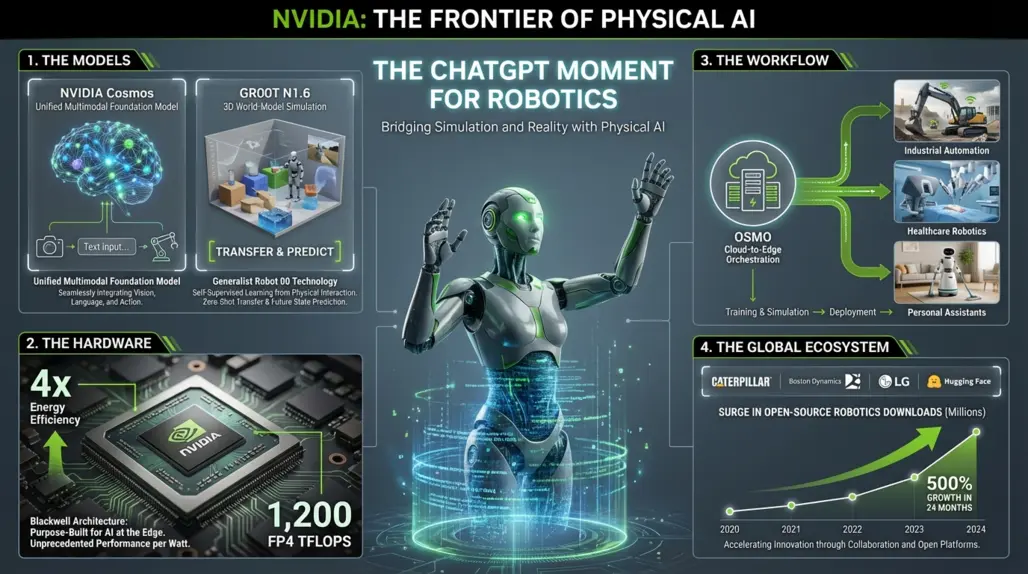
At CES 2026, NVIDIA announced a suite of new technologies designed to accelerate the development of physical AI. The release includes open foundation models, simulation frameworks, and new edge computing hardware. Founder and CEO Jensen Huang described this shift as the "ChatGPT moment for robotics," signaling a move toward generalist robots capable of reasoning and planning rather than just executing pre-programmed tasks.
For developers and founders in the robotics space, these updates address critical bottlenecks in training, benchmarking, and hardware accessibility.
Open Models to Skip Pretraining
One of the significant hurdles in robotics development is the capital required to build foundation models. NVIDIA is addressing this by releasing open models that allow engineers to bypass the pretraining phase and focus on fine-tuning for specific applications. This recent expansion of open models and datasets demonstrates NVIDIA's sustained commitment to democratizing AI development tools.
These models are now available on Hugging Face and include:
- NVIDIA Cosmos Transfer & Predict 2.5: These are customizable world models designed for physically based synthetic data generation. They allow developers to evaluate robot policies in simulation before deploying to the real world.
- NVIDIA Cosmos Reason 2: A vision language model (VLM) that gives machines the ability to process visual data and "reason" about their environment, acting more like humans.
- NVIDIA Isaac GR00T N1.6: Purpose-built for humanoid robots, this vision language action (VLA) model enables full-body control and utilizes Cosmos Reason for contextual understanding.
Streamlining Workflows with Isaac Lab-Arena and OSMO
Beyond models, the complexity of the development pipeline often slows down deployment. Benchmarking is frequently manual, and orchestrating compute resources across local workstations and the cloud can be disjointed.
To solve this, NVIDIA released Isaac Lab-Arena, an open-source framework for large-scale robot policy evaluation. It connects with industry standards like Libero and Robocasa to ensure robot skills are robust before they hit physical hardware.
Additionally, the new OSMO framework acts as a cloud-native command center. It allows developers to manage synthetic data generation, model training, and software-in-the-loop testing across heterogeneous compute environments. This unification aims to significantly reduce development cycles, working in tandem with concurrent advancements in cloud inference efficiency across NVIDIA's 2026 compute ecosystem.
Accelerating Open Source with Hugging Face
Recognizing the growth of the open-source robotics community, NVIDIA has deepened its collaboration with Hugging Face. The new Isaac and GR00T models are integrated into LeRobot, a leading open-source robotics framework.
This interoperability means developers can now use the LeRobot library for easy fine-tuning and evaluation of NVIDIA's models. For example, Hugging Face's open-source Reachy 2 humanoid is now fully compatible with NVIDIA's Jetson Thor robotics computer.
Jetson T4000: Blackwell Architecture at the Edge
For builders needing powerful compute at the edge, the new Jetson T4000 module brings the Blackwell architecture to autonomous machines.
Key specifications for the Jetson T4000 include:
- Performance: 1,200 FP4 TFLOPS (4x the performance of the previous generation).
- Memory: 64GB.
- Power: Configurable 70-watt envelope.
- Pricing: $1,999 (at 1,000-unit volume).
This module provides a substantial upgrade path for existing Jetson Orin users, specifically targeting energy-constrained autonomy in industrial and general robotics applications.
Global Adoption and Industry Impact
The practical application of these technologies is already visible across the global ecosystem. From Boston Dynamics in the US to NEURA Robotics in Germany and LG Electronics in South Korea, major players are integrating these stacks.
Developments range from surgical robots by LEM Surgical using Jetson AGX Thor to industrial humanoids from AGIBOT. The widespread adoption suggests that the industry is moving quickly to leverage these new reasoning capabilities for complex, unstructured environments.
Discover More AI Innovations
As physical AI continues to evolve and transform robotics development, staying informed about the latest tools and platforms is essential for builders and developers. Discover more cutting-edge AI tools and apps on Appse, your go-to directory for the latest AI innovations across robotics, machine learning, and autonomous systems.
Source: NVIDIA Releases New Physical AI Models as Global Partners Unveil Next-Generation Robots