
NVIDIA Expands Open Models, Data and Tools for AI
New Nemotron, Cosmos, Alpamayo, Isaac GR00T and Clara releases add open models, large datasets and practical blueprints for building production AI.
Overview
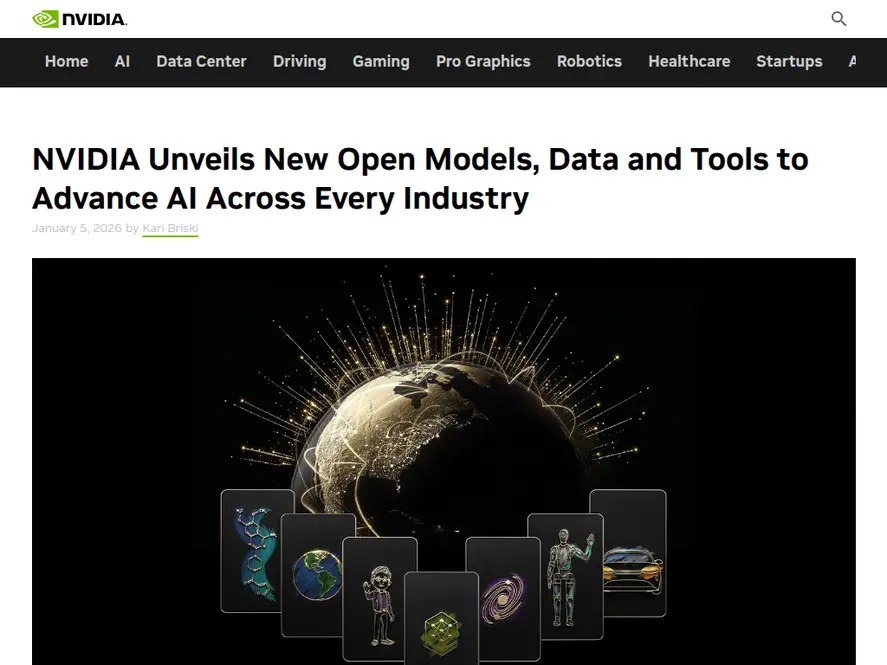
NVIDIA has expanded its open AI portfolio with new open models, datasets and developer tools designed to speed up real-world AI across industries. The drop spans agentic AI (Nemotron), physical AI and robotics (Cosmos and Isaac GR00T), autonomous vehicles (Alpamayo), and biomedical research (Clara). Alongside the models, NVIDIA is publishing training frameworks and what it describes as one of the largest collections of open multimodal data, aimed at making it easier for teams to train, evaluate and deploy production systems.
The company says the open data collection includes 10 trillion language tokens, 500,000 robotics trajectories, 455,000 protein structures and 100TB of vehicle sensor data. Major adopters cited include Bosch, CrowdStrike, Cohesity, Fortinet, Palantir, Salesforce, ServiceNow, Hitachi and Uber.
Key releases and what they do
Nemotron: speech, RAG and safety for AI agents
NVIDIA is adding three Nemotron tracks that map directly to common production needs: voice interfaces, retrieval pipelines and guardrails.
- Nemotron Speech: real-time, low-latency ASR models for captions and voice agents. NVIDIA points to benchmark results showing up to 10x faster performance than other models in its class.
- Nemotron RAG: new embedding and reranking vision language models to improve multilingual and multimodal retrieval, particularly for document search and technical knowledge bases. For teams building agent-based retrieval systems, these components also fit neatly into agentic AI workflows using apps like LangChain.
- Nemotron Safety: updated safety models including Llama Nemotron Content Safety (expanded language support) and Nemotron PII for sensitive data detection.
If you want more context on how NVIDIA has been iterating on its agent stack, see previous updates to the Nemotron ecosystem.
NVIDIA also released supporting assets such as an embedding dataset and training code for Llama Embed Nemotron 8B, an updated LLM Router blueprint for routing requests to the best-fit model, and the dataset used to build the latest Nemotron Speech ASR model.
Cosmos and Isaac GR00T: foundations for physical AI
Physical AI systems need models that can perceive and reason about the world, plus data to simulate edge cases. NVIDIA is releasing Cosmos open world foundation models focused on world understanding and synthetic data generation.
- Cosmos Reason 2: a reasoning VLM positioned for stronger physical-world understanding.
- Cosmos Transfer 2.5 and Cosmos Predict 2.5: models for generating large-scale synthetic videos across varied environments.
For robotics, NVIDIA released Isaac GR00T N1.6, an open reasoning vision language action model aimed at humanoid control, built on Cosmos Reason. There is also a video search and summarization blueprint under Metropolis for building vision AI agents that can analyze recorded and live video.
Alpamayo: reasoning-based autonomous vehicle development
NVIDIA introduced Alpamayo, a family of open models, simulation tools and datasets for autonomous driving workflows.
- Alpamayo 1: an open reasoning vision language action model for AVs that can interpret scenes and explain actions.
- AlpaSim: an open-source simulation framework for closed-loop training and evaluation across edge cases.
NVIDIA is also publishing Physical AI Open Datasets with 1,700+ hours of driving data collected across diverse geographies and conditions.
Clara: open models for biomedical AI
New Clara models target faster, cheaper drug discovery and validation:
- La-Proteina for atom-level protein design
- ReaSyn v2 for synthesis-aware drug design
- KERMT for early computational safety testing
- RNAPro for predicting 3D RNA structures
An additional dataset of 455,000 synthetic protein structures is intended to improve bio model training.
Impact for developers
For builders, the practical shift is not just more models, but more complete building blocks:
- Reference-grade components for pipelines (ASR, embeddings, reranking, safety)
- Open datasets at unusual scale, useful for training, fine-tuning and evaluation
- Simulation-first workflows for robots and AVs, enabling iterative testing before real-world rollout
NVIDIA says models and resources are available via GitHub, open-source AI platforms like Hugging Face and build.nvidia.com, and many are also offered as NVIDIA NIM microservices for deployment on NVIDIA-accelerated infrastructure from edge to cloud. That deployment angle also connects to NVIDIA's broader push around reducing operational costs for AI inference.
What to watch next
If these releases gain traction, expect faster experimentation cycles around multimodal RAG, better safety baselines for enterprise agents, and more teams using synthetic data to cover long-tail physical-world scenarios in robotics and autonomous driving.
Discover more cutting-edge AI tools and apps on Appse, your go-to directory for the latest AI innovations.