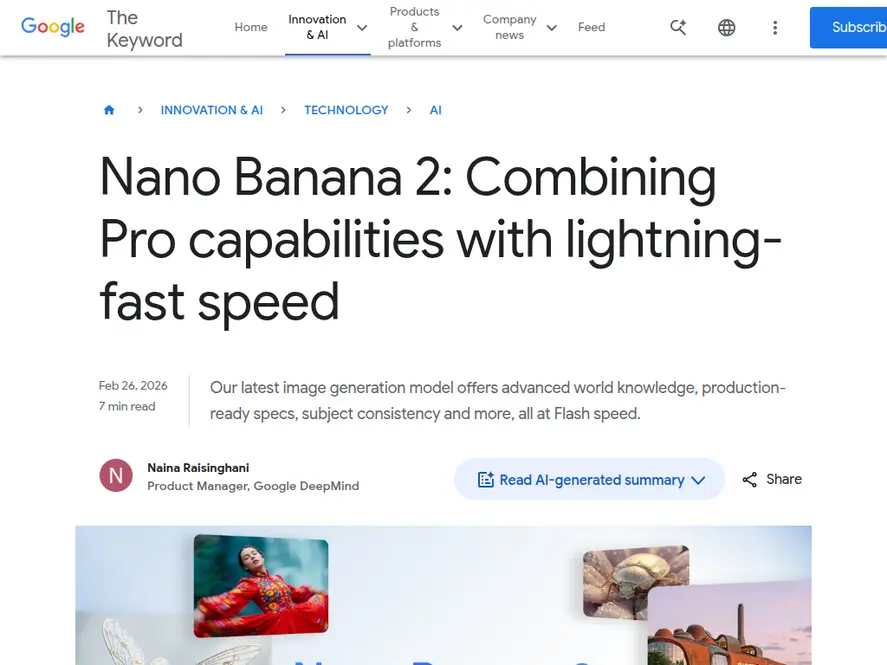
Google Unveils Nano Banana 2: A New Era of High-Fidelity, Low-Latency Image Generation
Google DeepMind has officially released Nano Banana 2 (also technically designated as Gemini 3.1 Flash Image), marking a significant shift in how developers and creators approach AI-generated media. By engineering a model that bridges the gap between "Pro" tier capabilities and "Flash" tier latency, Google is effectively democratizing high-end image synthesis for real-time applications.
For builders and founders, this update addresses the critical trade-off between quality and speed, offering a solution that delivers production-ready assets without the inference lag typically associated with foundation models of this caliber.
The Convergence of Speed and Intelligence
Historically, developers have had to choose between lightweight models for speed (often sacrificing detail) and heavy models for quality (sacrificing latency). Nano Banana 2 dismantles this dichotomy. It integrates the advanced reasoning and world knowledge previously exclusive to Nano Banana Pro into a high-speed architecture.
This architectural shift enables rapid iteration cycles, making it feasible to implement high-quality image generation in latency-sensitive environments like real-time user interfaces, dynamic ad generation, and interactive storytelling apps.
Key Technical Specifications for Builders
- Resolution & Aspect Ratios: Native support for outputs ranging from 512px up to 4K, giving developers full control over aspect ratios for diverse platforms (mobile vertical, widescreen headers, etc.).
- Prompt Adherence: Significantly improved instruction following, allowing for complex, multi-clause prompts that are respected with high precision.
- Inference Speed: optimized for "Flash" speed, facilitating near-instantaneous editing and generation workflows.
Breakthroughs in Consistency and Control
One of the most persistent challenges in generative AI development has been subject consistency, the ability to generate the same character or object across different scenes. Nano Banana 2 introduces robust mechanisms to handle this:
- Multi-Subject Preservation: The model can maintain the identity of up to five distinct characters and the fidelity of 14 distinct objects within a single workflow. This is a game-changer for developers building storyboarding tools, comic generators, or consistent brand asset platforms.
- Text Rendering & Localization: Addressing the notorious "gibberish text" issue, the new model renders accurate, legible text for localized marketing materials. It supports translation and localization directly within the image generation process, a massive boon for global SaaS platforms targeting multiple regions.
Integration and Global Availability
Google is aggressively rolling out Nano Banana 2 across its ecosystem, making it immediately accessible for integration:
- Developer Access: Available now in preview via Google AI Studio and the Gemini API, as well as on Vertex AI for enterprise-grade deployments.
- Consumer Integration: It replaces the previous Pro model in the Gemini app for standard tasks and serves as the default engine for Flow (available at zero credits).
- Search & Ads: The model is powering visual results in Google Search (AI Mode and Lens) and campaign creation tools in Google Ads.
In terms of GEO optimization, the rollout includes support for 141 new countries and territories, along with eight additional languages, ensuring that builders can deploy globally compliant applications from day one.
Trust and Provenance Architecture
As AI-generated content scales, verification becomes non-negotiable. Nano Banana 2 is deeply integrated with Google's provenance infrastructure:
- SynthID: Google's imperceptible watermarking technology is embedded by default.
- C2PA Content Credentials: The model supports open technical standards for content provenance, allowing downstream applications to verify the origin of assets. This is critical for developers building in regulated industries or news media sectors where authenticity is paramount.
Why This Matters for the Dev Ecosystem
The release of Nano Banana 2 signals that "production-ready" AI is becoming faster and cheaper. For the developer ecosystem, the ability to generate 4K, text-accurate, and subject-consistent imagery at high speeds opens new vertical opportunities in automated marketing, gaming assets, and personalized e-commerce experiences.
By moving these capabilities into the "Flash" tier, Google is likely lowering the cost-per-generation barrier, enabling startups to build feature-rich visual applications with healthier unit economics.
Discover More AI Innovation
Looking to explore other cutting-edge AI tools that can transform your workflow? Discover more innovative AI applications and platforms on Appse, your comprehensive directory for the latest AI technologies and tools.
Source: Google Blog - Nano Banana 2