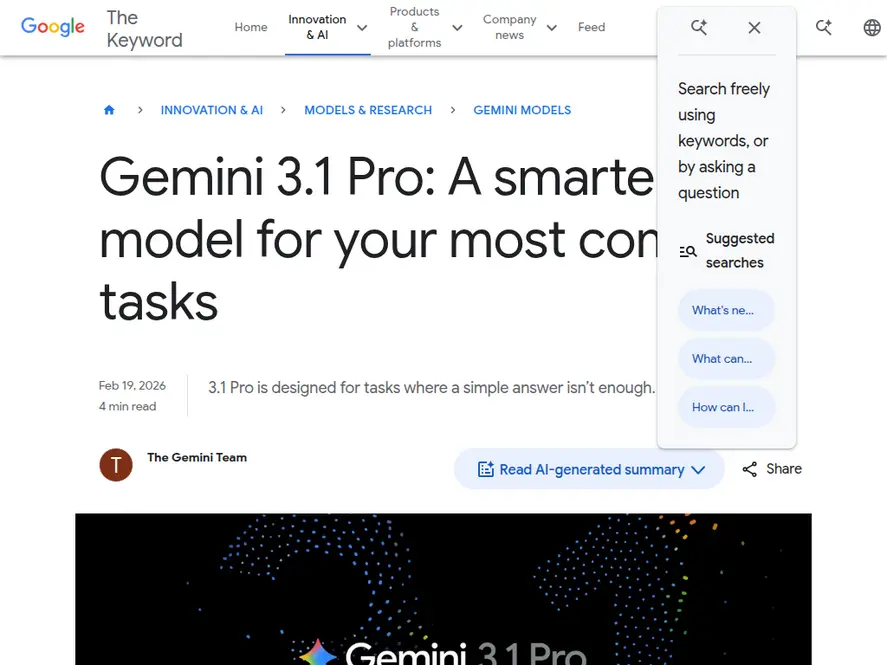
Google has officially unveiled Gemini 3.1 Pro. This update brings significant improvements to the core intelligence of the Gemini family. It is designed specifically for tasks that require deep reasoning rather than simple information retrieval. For developers and founders building complex agents, this model offers a new baseline for performance.
A New Standard in AI Reasoning
The standout feature of this release is the performance on the ARC-AGI-2 benchmark. This test evaluates how well an AI can handle entirely new logic patterns it has not seen before. Gemini 3.1 Pro achieved a verified score of 77.1 percent. This is more than double the score of its predecessor, Gemini 3 Pro.
High scores on benchmarks like this usually translate to better reliability in real world applications. When an AI needs to navigate a multi-step workflow or debug complex code, raw reasoning power matters more than simple knowledge retention.
Key Capabilities for Developers
The model is not just about answering questions. It is built to execute tasks. Google showcased several practical applications that highlight why this matters for software engineers working with AI coding and developer tools.
- Pure Code Animation: The model can generate animated SVGs from text prompts. These are code based rather than pixel based, keeping file sizes small and graphics crisp.
- System Synthesis: It can bridge the gap between complex APIs and user interfaces. In one demo, the model successfully configured a public telemetry stream to visualize the International Space Station orbit in a live dashboard.
- Interactive Prototyping: Designers can use the model to code immersive 3D experiences. It creates the visual code and the logic for user interaction.
- Creative Coding: The model can translate abstract literary themes into functional, modern web designs, moving beyond summary to actual creation.
Technical Specifications and Agentic Workflows
Gemini 3.1 Pro comes with a 1 million token context window. This large context allows the model to ingest vast amounts of documentation, video, or code bases in a single prompt. It supports multimodal inputs, including text, audio, images, video, and code.
This capacity supports agentic workflows. An agentic workflow involves an AI planning a series of actions to achieve a goal. With improved reasoning and a large context window, the model can maintain the thread of a complex task without losing track of the initial instructions or the data constraints. This makes it particularly useful for synthesizing data into single views or explaining complex topics visually, capabilities essential for building autonomous AI agents.
Global Availability and Access
Google is rolling out Gemini 3.1 Pro in preview starting now. It is accessible across several platforms for different types of users worldwide.
- For Developers: Access is available via the Gemini API in Google AI Studio, Google Antigravity, and the Gemini CLI.
- For Enterprise: The model is integrated into Vertex AI and Gemini Enterprise.
- For Mobile Devs: Android Studio now supports the new model for integrating AI features into mobile apps.
- For Consumers: Advanced users can access it via the Gemini app and NotebookLM (specifically for Pro and Ultra users).
This release serves as a validation phase. Google is gathering feedback from the builder community to refine the model before a wider general release. Builders looking to leverage advanced reasoning for autonomous agents or complex system design can start testing the endpoints today.
Discover More AI Tools
If you're interested in exploring advanced AI models and development tools like Gemini 3.1 Pro, discover more cutting-edge AI applications on Appse, your comprehensive directory for the latest AI innovations across coding, automation, and intelligent systems.