
OpenAI Targets Late 2026 for Debut of First AI Device
Bringing Jony Ive's design philosophy to AI hardware, aiming for a "peaceful" alternative to smartphones.
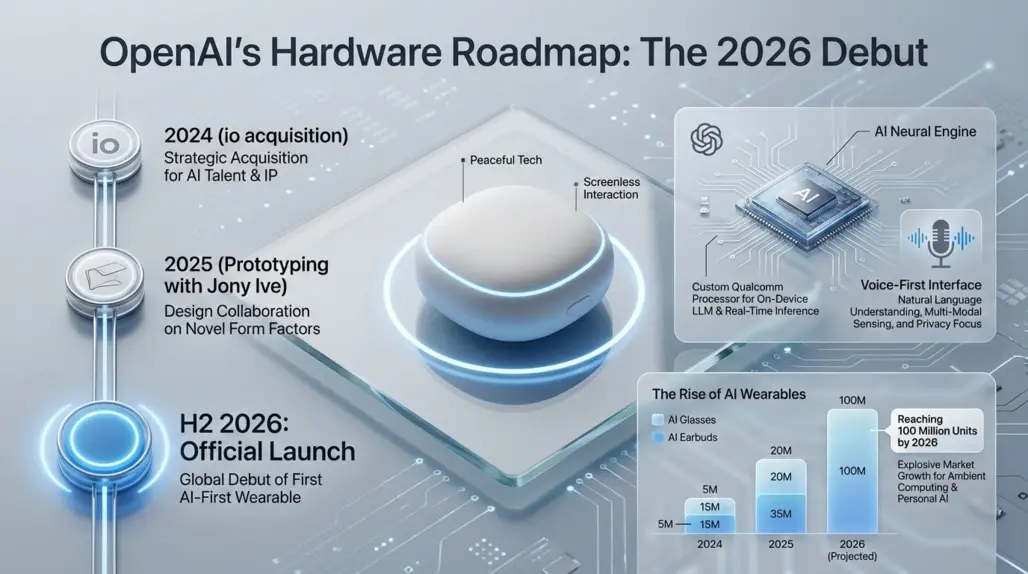
At the World Economic Forum in Davos, OpenAI finally offered a concrete timeline for one of Silicon Valley's most anticipated hardware projects. Chris Lehane, the company's chief global affairs officer, confirmed that OpenAI is on track to unveil its first dedicated device in the second half of 2026.
This announcement marks a significant pivot for the AI giant, moving from software dominance exemplified by conversational AI platforms like ChatGPT to physical consumer products. It follows the acquisition of former Apple design legend Jony Ive's company, previously known as io, last May. While details remain tightly guarded, the timeline aligns with earlier hints from Ive's team about sharing their work in 2026.
A "Peaceful" Shift in Computing
For developers and founders watching the hardware space, the language surrounding this device suggests a departure from the attention economy models of current smartphones. CEO Sam Altman has described the upcoming hardware as "peaceful" and noted that users might be shocked by its simplicity.
Reports indicate the device will likely be screenless and potentially wearable. This aligns with a growing trend in "ambient computing," where technology recedes into the background rather than demanding constant visual attention. For builders, this signals a potential shift in how applications are designed. If the primary interface is voice or context-based rather than visual, the latency and conversational capabilities of the underlying models become the critical user interface elements.
The Hardware Landscape
OpenAI is entering a market that has seen recent high-profile stumbles. Early attempts at dedicated AI gadgets, such as the Humane AI Pin, failed to gain traction due to performance issues and a lack of clear utility over smartphones. However, the ecosystem is maturing rapidly.
Qualcomm CEO Cristiano Amon, also speaking at Davos, noted that the market for AI-equipped glasses is expanding significantly. He projects shipments could climb from 10 million to 100 million units annually within the next year or two. While Lehane declined to specify if OpenAI's device is a pin, earpiece, or eyewear, Amon confirmed Qualcomm has been working with OpenAI, though he left the specifics for OpenAI to announce.
Implications for Developers
The arrival of an OpenAI device in late 2026 introduces several considerations for the developer community:
- Voice-First Interfaces: If the device is screenless, reliable speech-to-speech capabilities will be paramount. Developers may need to optimize for audio-only user flows, potentially leveraging real-time voice AI platforms such as Vapi to build the low-latency experiences these devices demand.
- Contextual Awareness: A "simple" device likely relies heavily on context to be useful. This suggests future APIs may offer deeper integration with real-time environment data, building on the conversational capabilities that define modern AI assistants.
- New Form Factors: Whether it is smart eyewear or a subtle wearable, the move away from rectangular screens challenges the current paradigm of app development.
While Lehane managed expectations by stating they will "see how things advance," the commitment to a 2026 reveal suggests the prototype phase is maturing into a production reality. For the tech industry, the question is no longer if OpenAI will build hardware, but whether Jony Ive's design philosophy can successfully define the post-smartphone era.
As the AI hardware landscape continues to evolve, discover more cutting-edge AI tools and applications on Appse, your go-to directory for exploring the latest innovations in artificial intelligence.