
Microsoft brings agentic AI automation to retail
New Copilot commerce and agent templates aim to unify merchandising, discovery, and store ops for faster, more resilient retail execution.
Overview
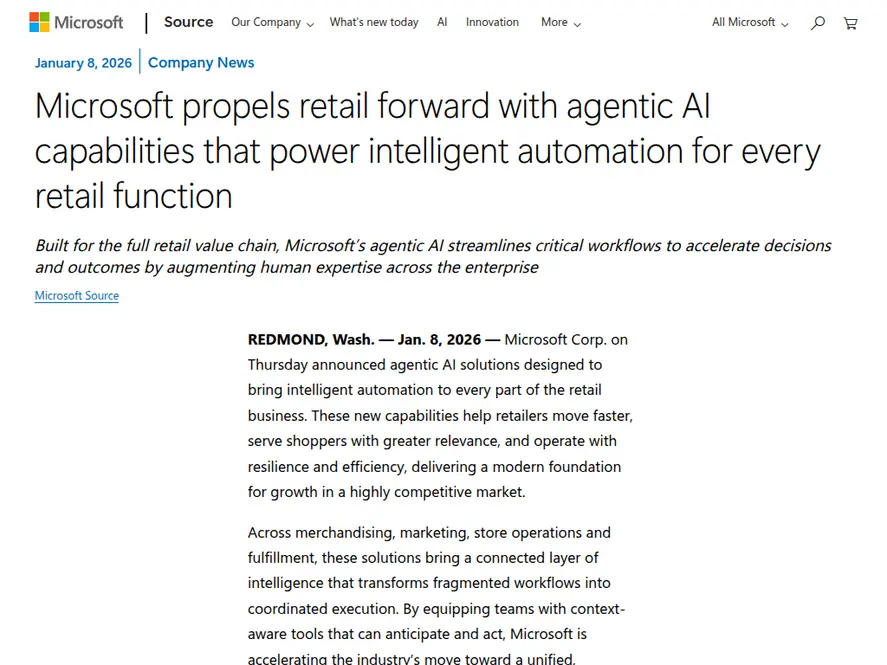
Microsoft announced a set of agentic AI solutions for retail that target automation across the full value chain, from digital commerce and marketing to store operations and fulfillment. The company positions these apps as a connected layer of intelligence that reduces fragmented workflows and helps retailers execute faster with more consistent context.
At a time when AI is reshaping shopping behavior, Microsoft is betting that retailers need systems that do more than answer questions. They need agents that can anticipate intent, take actions across apps, and coordinate work across teams.
For additional platform context behind these retail templates, it helps to look at Microsoft's broader Agent Factory and AI developer updates.
What Microsoft announced
The release centers on commerce experiences powered by Microsoft Copilot plus a set of reusable agent templates in Copilot Studio:
- Copilot Checkout for in-conversation purchasing
- Brand Agents for retailer-owned sites, starting with Shopify merchants
- Personalized shopping agent template for custom retail shopping experiences
- Catalog enrichment agent template (public preview) for structured product data and onboarding automation
- Store operations agent template (public preview) for frontline decision support and workflow orchestration
Kathleen Mitford, Corporate Vice President of Global Industry at Microsoft, said the retailers that win will be those that unify the business with intelligence across the value chain, automating what slows teams down while improving customer relationships.
Key features builders should know
Copilot Checkout: conversation to purchase
Copilot Checkout lets shoppers complete purchases discovered within Copilot without being redirected to external sites. Microsoft says merchants remain the merchant of record, while partners including PayPal, Shopify, and Stripe help enable the experience. Copilot Checkout is available in the U.S. on Copilot.com, with participating brands including Urban Outfitters, Anthropologie, Ashley Furniture, and Etsy sellers.
From an implementation standpoint, this pushes checkout closer to where intent forms, which can reduce drop-off caused by redirects, form re-entry, and session breaks.
Brand Agents and a shopping agent template
Microsoft introduced:
- Brand Agents, a turnkey option designed to speak in a brand-aligned voice and answer product questions based on a product catalog. It is available for merchants on the Shopify platform.
- A personalized shopping agent template in Copilot Studio, meant for deeper customization across web, mobile, and in-store experiences. Microsoft highlights capabilities like real-time product discovery and recommendations, plus advanced flows such as outfit building.
Catalog enrichment: making product data usable by agents
In public preview, the catalog enrichment agent template in Copilot Studio extracts product attributes from images, adds signals such as social insights, and automates catalog workflows like onboarding, categorization, and error resolution.
For teams thinking beyond customer-facing chat and into supply-side automation, this is also where complementary tools can fit. For example, AI-powered B2B sourcing engines like Accio can support upstream product discovery and supplier-side workflows that benefit from cleaner, structured product data.
For developers, this matters because agent performance in retail often fails at the data layer. Enriched, structured catalog data is what enables reliable retrieval, better recommendations, and consistent answers across channels.
Store operations agent template: frontline help with context
Also in public preview, the store operations agent template provides a natural language interface for questions like inventory availability or store policy, and can orchestrate workflows, flag exceptions, and suggest next best actions.
Microsoft says the agent can incorporate internal signals (sales trends, foot traffic) and external factors (weather, local events, holidays) to recommend staffing adjustments, KPI focus, and operational priorities.
Impact for developers and retail tech teams
These announcements point to a practical architecture shift: retail experiences and operations are moving from single-purpose bots to action-capable agents that sit on top of commerce platforms, payment providers, and internal operational systems.
This direction also tracks the broader industry move toward evolving agent-to-user interface frameworks, where agents do not just converse, but plan and execute within real software surfaces.
Teams evaluating this stack should plan for:
- Identity and permissions that match real store and commerce roles
- Grounding and governance for catalog and policy knowledge
- System integration across OMS, inventory, CRM, and helpdesk workflows
- Observability to audit agent actions, not just chat logs
Availability and where this goes next
Copilot Checkout is live in the U.S. on Copilot.com. Brand Agents and the agent templates are delivered through Copilot Studio, with catalog enrichment and store operations templates in public preview. Microsoft also highlighted availability through its marketplace and planned demonstrations at NRF 2026.
For retail builders, the near-term opportunity is to pilot one workflow with clear ROI, such as catalog onboarding automation or store policy and inventory assistance, then expand toward end-to-end agentic orchestration.
Discover more cutting-edge AI tools and apps on Appse, your go-to directory for the latest AI innovations.