
Home Depot and Google Cloud Ship Agentic AI Tools
Gemini-powered agents bring projects from advice to action, spanning in-store guidance, pro materials lists, delivery intelligence, and customer support.
Overview
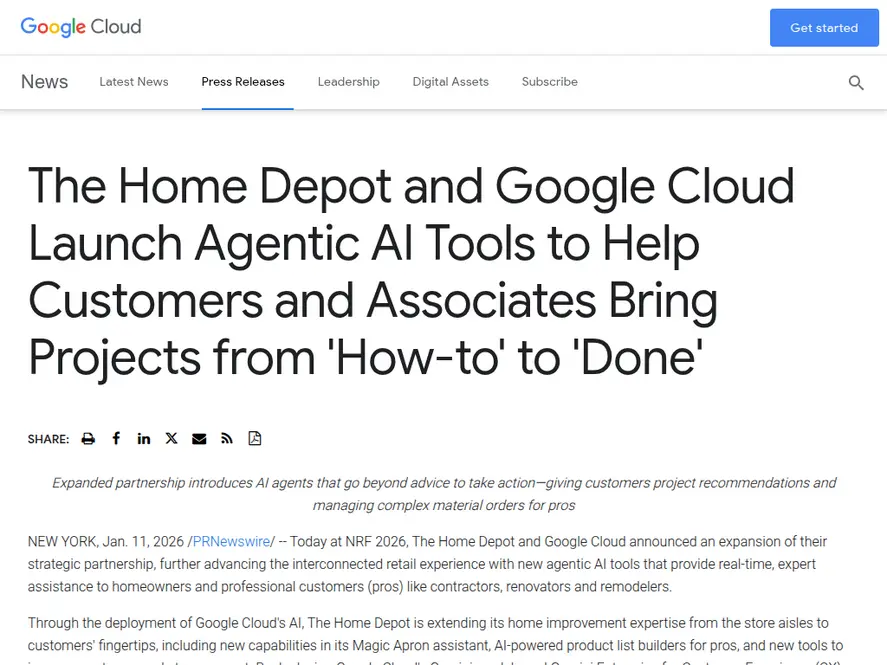
The Home Depot and Google Cloud have expanded their strategic partnership to roll out agentic AI apps designed to move beyond product recommendations and actually help customers and associates complete home improvement projects. Announced at NRF 2026, the initiative centers on Google Cloud Gemini models and Gemini Enterprise for Customer Experience (CX), aiming to deliver a more personalized, contextual experience across digital channels, physical stores, and job sites. For additional technical context on the model family that enables low latency, real-time experiences, see Google's Gemini 3 Flash model performance capabilities.
A notable near-term shift is distribution: The Home Depot says these capabilities will also show up in agentic shopping experiences across AI Mode in Google Search and in the Gemini app in the coming months, extending the retailer’s expertise beyond its own properties.
What “agentic AI” means here
In this rollout, “agentic” refers to AI systems that can interpret intent and take steps to complete tasks, not just answer questions. For retail and home improvement, that includes actions like building a materials list, checking local inventory, guiding a shopper to a specific bay in a store, or predicting delivery risks before a truck rolls out. In the broader retail landscape, this direction echoes Microsoft's similar rollout of agentic AI automation for retail operations, signaling a wider shift from chatbots to task completion.
Key features shipping across the stack
Magic Apron becomes a conversational project companion
The Home Depot has significantly expanded Magic Apron from an on-page helper into a conversational assistant across its digital platforms.
Key capabilities include:
- Plain-language project support for DIY and pro scenarios, from small repairs to remodel planning
- Personalized recommendations that go beyond search-style results
- Planned multimodal features like image upload and visualization for guided project help
A localized in-store AI agent with aisle-level precision
A new in-store Magic Apron experience blends AI guidance with real-time local inventory and store wayfinding.
What it enables:
- Location-aware answers that include where to find items, down to the exact bay
- Contextual add-on suggestions (tools, consumables, complementary materials)
- Pilot testing in select stores, with a nationwide rollout planned in the coming months
AI-powered materials lists for pros
For contractors, renovators, and remodelers, The Home Depot is scaling an AI materials list feature on its pro site.
How it works:
- Pros describe a job by voice or text, or upload an existing list
- The agent infers project intent and generates grouped materials lists
- It can suggest missing essentials required to finish the job
This feature launched in beta in November 2025 and is scaling nationally in January 2026, with a focus on speeding estimating and quote generation.
Route intelligence for last-mile delivery
The Home Depot is using Gemini with Google Maps Platform to predict and prevent delivery failures.
The system layers:
- Customer-specific constraints (operating hours, drop-off preferences)
- External signals (weather, road quality)
- Multimodal interpretation of map context to identify access blockers (narrow roads, gated entries, unpaved streets)
The goal is to reduce failed deliveries and, over time, recommend appropriate equipment and crew size for complex drop-offs.
Conversational support across chat, SMS, and voice
The Home Depot is replacing menu-driven automation with conversational AI that understands intent across SMS, chat, and phone. The company says it is already live and improving engagement and resolution outcomes, and it is now testing next-generation AI voice agents in select stores to help associates focus on more complex cases.
Impact for developers and builders
For teams building retail and enterprise agents, this partnership is a real-world blueprint for shipping agentic systems across channels with shared intelligence.
Practical takeaways:
- Multimodal inputs matter: image upload, voice, and map context are becoming standard for task completion
- Retrieval plus action is the bar: “answering” is less valuable than generating lists, validating constraints, and routing work
- Localization is a differentiator: real-time inventory and store mapping turn generic assistants into operational tools
- Agent safety and correctness become product features: materials lists, delivery risk predictions, and CX automation need strong guardrails, validation, and auditability
If you are prototyping systems like this, frameworks for multi-agent AI automations can be useful for orchestrating specialized agents (for example, inventory checks, list generation, and policy validation) into a single task-oriented workflow.
What to watch next
Two near-term milestones could define adoption:
- Expansion into AI Mode in Google Search and the Gemini app, which could shift discovery and conversion flows outside retailer-owned surfaces
- Nationwide rollout of the in-store localized agent, where accuracy and latency will make or break trust at aisle level
As agentic AI moves from demos into store operations, The Home Depot’s approach shows how developers can connect LLMs to real inventory, logistics, and support systems to deliver outcomes, not just answers.
Discover more cutting-edge AI apps and apps on Appse, your go-to directory for the latest AI innovations.