Unlocking the Non-Coding Genome
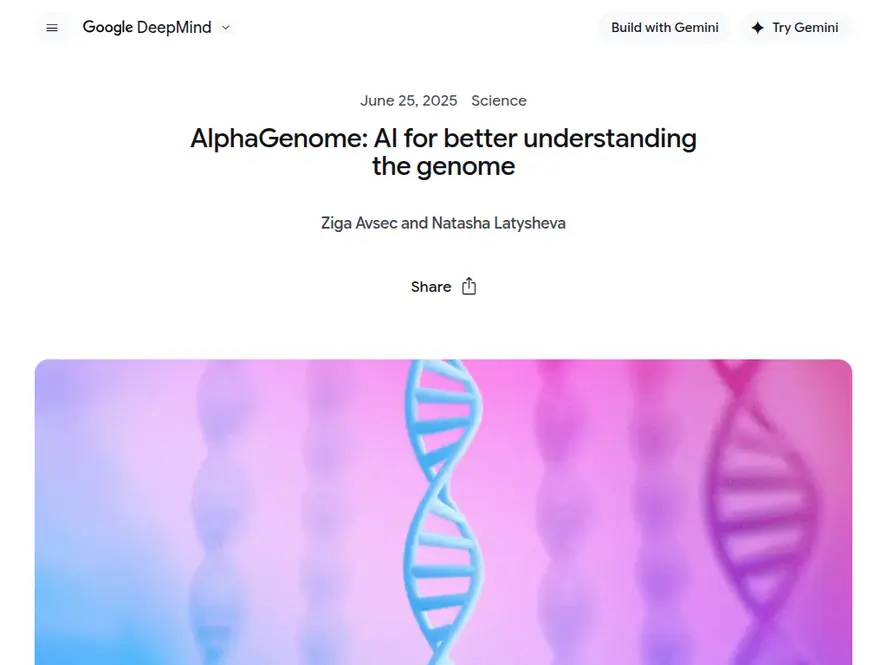
For years, the biotech and computational biology sectors have focused heavily on the 2% of the human genome that codes for proteins. While critical, this left the remaining 98% (often called the "dark genome") largely unexplored regarding its functional role in disease and regulation. Google DeepMind has introduced AlphaGenome, a foundation model designed to bridge this gap. By analyzing raw DNA sequences, this tool predicts how genetic variants influence biological processes, offering builders and researchers a new lens into gene regulation.
This release marks a shift from specialized models to a unified architecture. AlphaGenome does not just look at protein structure; it predicts regulatory activity, RNA splicing, and gene expression directly from the sequence. For developers working on diagnostic tools or synthetic biology platforms, this provides a way to score genetic mutations computationally before heading to the wet lab.
Technical Architecture: Convnets Meet Transformers
The core innovation behind AlphaGenome lies in its ability to process effectively long sequences of DNA. The model takes up to 1 million base pairs (letters) as input. This context window is crucial because gene regulation often involves interactions between DNA segments that are far apart on the strand.
To achieve this, the architecture utilizes a hybrid approach:
- Convolutional Layers: These initially scan the sequence to detect short, local patterns and motifs.
- Transformers: These layers communicate information across the entire 1 million base-pair sequence, capturing long-range dependencies.
- Multimodal Heads: The final layers translate these patterns into predictions for diverse molecular properties, such as chromatin accessibility and RNA production.
DeepMind trained this system using data from major genomic consortia like ENCODE and GTEx, distributing the computation across interconnected TPUs. This setup allows the model to maintain base-level resolution, meaning it can pinpoint effects down to a single DNA letter.
Implications for Developers and Builders
The release of the AlphaGenome API offers immediate practical utility for those building in the life sciences space. Previously, analyzing different aspects of gene regulation required stitching together multiple disparate models. AlphaGenome acts as a generalist, handling multiple modalities in a single inference pass.
Key capabilities for technical teams include:
- Efficient Variant Scoring: The model can assess the impact of a genetic variant in roughly one second. It does this by contrasting the predictions of a mutated sequence against a reference sequence, highlighting potential functional changes instantly.
- Splice-Junction Modeling: Errors in RNA splicing cause many rare diseases. AlphaGenome explicitly models these junctions, providing insights into how variants might disrupt cellular instructions.
- Foundation for Fine-Tuning: As a foundation model, it learns a general representation of genomic rules. This makes it a strong candidate for transfer learning, allowing developers to adapt the model to proprietary datasets or specific tissue types.
Current Limitations
While powerful, AlphaGenome is not a replacement for clinical validation. The model excels at predicting molecular properties but does not fully map how these properties manifest as complex diseases or traits, which often involve environmental factors. Additionally, while the 1 million base-pair context is significant, capturing interactions beyond this range (over 100kb distances) remains a computational challenge.
For the builder community, AlphaGenome represents infrastructure. It is a tool to filter and prioritize hypotheses, accelerating the discovery pipeline from years to days.
Discover More AI Innovation
As AI continues to transform scientific research and genomics, tools like AlphaGenome are paving the way for breakthrough discoveries. If you're interested in exploring more cutting-edge AI applications across various domains, from research to data analytics and beyond, visit Appse, your comprehensive directory for the latest AI tools and innovations.