
AI-Driven Innovations Reshaping Software Development in 2026
How new tools for security, monitoring, and quality assurance are maturing the AI development landscape
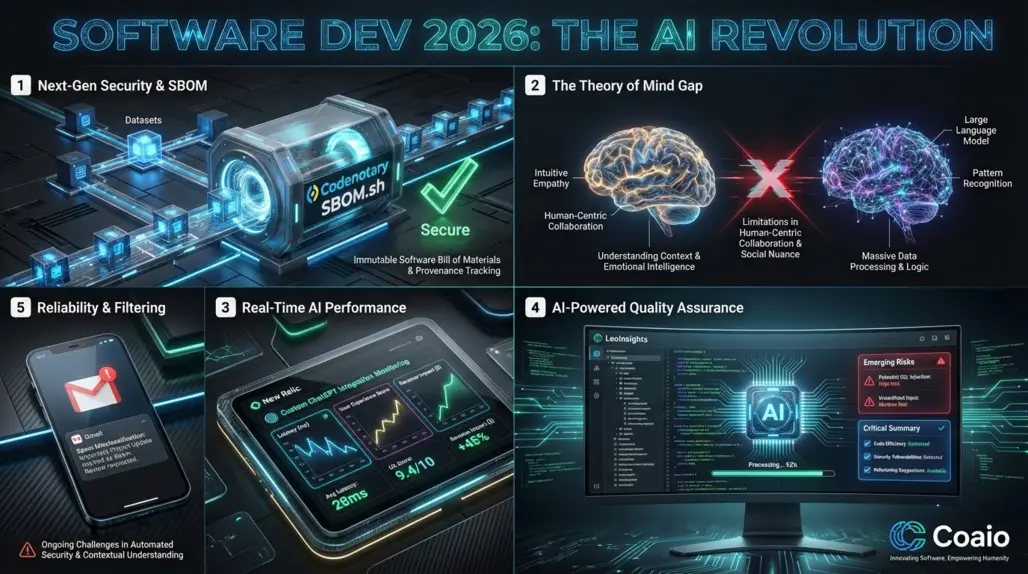
As we move through January 2026, the software development landscape is being defined by a pragmatic integration of artificial intelligence. The hype phase has settled, replaced by a focus on security, reliability, and measurable performance. For builders and founders, the latest industry updates highlight a crucial shift. We are no longer just asking what AI can generate, but how we can secure, monitor, and trust these systems in production environments.
Here is a look at the critical innovations and discussions currently shaping the developer ecosystem, with insights into the AI coding and developer tools transforming how we build software.
Securing the AI Supply Chain
Security remains a top priority, particularly regarding the components that make up modern applications. Codenotary has made a significant move by enhancing its SBOM (Software Bill of Materials) service to specifically address AI-driven software.
In the past, SBOMs primarily tracked code libraries and dependencies. However, AI applications rely heavily on data. Codenotary's latest update treats datasets as critical artifacts within the software supply chain. This allows developers to track the provenance and integrity of the data used to train models.
- Why this matters: AI models are only as good as their training data. By validating datasets alongside code, teams can better identify vulnerabilities and potential biases before deployment. Tools like recent open-source frameworks for behavioral evaluation are emerging to help developers implement these validation strategies more effectively.
- The impact: This offers a more granular level of transparency, which is essential for meeting emerging regulatory standards and ensuring client trust.
The Limits of Machine Cognition
While tools are getting smarter, there is a growing conversation about what AI still cannot do. Recent industry analysis has highlighted the limitations of Large Language Models (LLMs) regarding "Theory of Mind." This is the human ability to attribute mental states to others and understand that their perspectives differ from one's own.
For developers, this distinction is vital. LLMs are excellent at pattern recognition and syntax generation, making them powerful coding assistants. However, they lack the empathy and contextual awareness required for complex problem-solving that involves user sentiment or team dynamics. This realization is helping teams align their expectations, using AI for technical execution while relying on human engineering leaders for architectural decisions and user experience strategy.
Real-Time Monitoring for AI Applications
Building an AI feature is one thing; keeping it running smoothly is another. New Relic has introduced new monitoring capabilities specifically designed for custom ChatGPT applications.
This update provides developers with real-time visibility into the performance of their conversational AI integrations. Key metrics now include:
- Response latency and throughput
- Error rates in AI generation
- User interaction quality
For founders building on top of OpenAI's APIs, this visibility is critical. It transforms AI from a "black box" into a measurable component of the tech stack, allowing for rapid debugging and performance optimization that directly correlates to user retention. Access to predictive analytics and monitoring tools has become essential for teams seeking to maintain reliability in their AI-powered applications.
Automated Quality Assurance
Quality assurance is also seeing a shift toward predictive analysis. Testlio recently launched LeoInsights, an AI-driven platform powered by their LeoAI Engine. Drawing from over a decade of testing data, this tool does not just run tests; it analyzes patterns to predict where bugs are likely to occur.
This approach moves QA from a reactive process to a proactive one. By highlighting emerging risks and providing executive summaries of code changes, it helps development teams catch issues early in the cycle. For startups operating with lean teams, this kind of automated insight can significantly reduce the time spent on manual regression testing. Beyond predictive capabilities, enterprise initiatives deploying AI agents to autonomously fix bugs are showcasing the next frontier in automated quality assurance.
The Reliability Reality Check
Despite these advancements, the industry recently faced a reminder that software reliability is an ongoing battle. Gmail experienced significant issues with spam detection and email misclassification, impacting users globally. This incident serves as a stark reminder for builders: even the most sophisticated algorithms can fail. It underscores the need for robust fallback mechanisms and continuous human oversight in automated systems, especially those handling critical communications.
For developers in 2026, the message is clear. Innovation is not just about adopting the newest AI model. It is about building the infrastructure (security, monitoring, and QA) that makes those models viable for the real world.
Discover more cutting-edge AI tools and applications on Appse, your comprehensive directory for the latest AI innovations transforming software development and beyond.
Source: AI-Driven Innovations Reshaping Software Development in 2026