SeaVerse debuts AI-native platform for idea to deploy
The “All in AI Native” workspace unifies multimodal generation, preview, publishing, and team iteration using a single prompt.
Overview
SeaVerse has announced the global launch of what it calls the world’s first AI-native creation and deployment platform, branded “All in AI Native.” The release positions the SeaVerse AI-native platform as an attempt to fix a problem many builders already feel: creating with AI often means stitching together multiple apps for text, images, video, agent workflows, previews, and hosting.
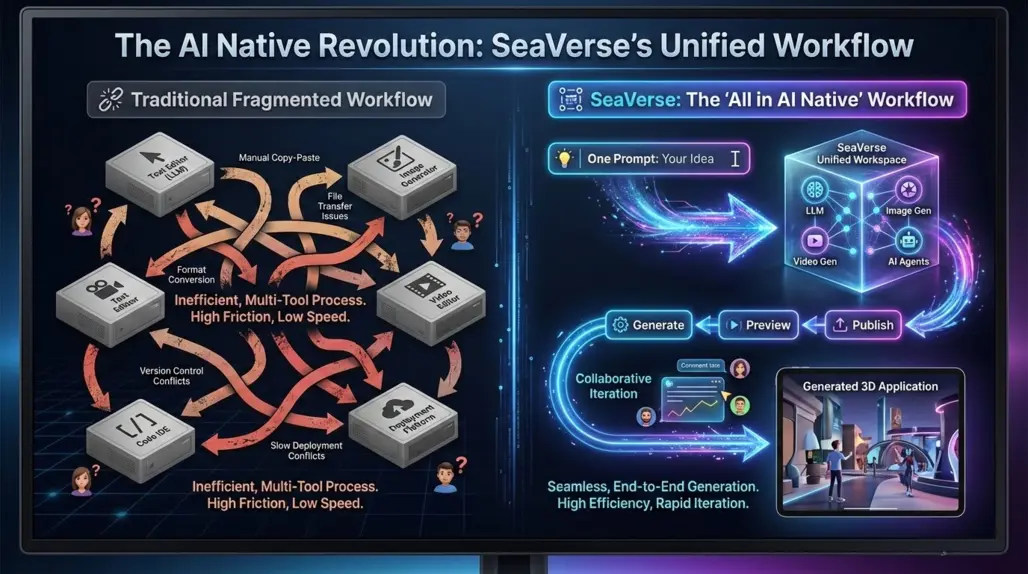
Instead of bouncing between separate products, SeaVerse claims to provide an end to end loop inside one workspace. The pitch is straightforward for developers and founders: describe what you want in natural language, see a working result immediately, then publish it online without extra setup.
What “AI-native” means in this context
In this announcement, “AI-native” is less about adding a chatbot to an existing editor and more about making generation, runtime preview, deployment, and iteration first class parts of the same system.
SeaVerse says it integrates:
- Large language models for instruction following and app logic scaffolding
- Image generation for visual assets and UI elements
- Video generation for media creation
- AI agents to help automate steps across the build process, building on ideas seen in a specialized agent-to-user interface framework where agents plan and render UI actions more directly
The result, according to the company, is that users can package “any creative idea” into a demo, application, or web page with a single prompt.
Key features SeaVerse highlights
Single prompt to product
SeaVerse is designed to take a natural language prompt and generate a deployable artifact such as:
- A product demo
- A lightweight application
- A web page
This matters because it shifts AI output from static content to something that runs, can be tested, and can be shared. It also puts SeaVerse in the same broader movement as tools emphasizing AI-powered design tool and interactive prototyping capabilities, where the output is meant to be interacted with, not just viewed.
Unified build, preview, publish, iterate loop
The platform emphasizes an integrated workflow:
- Generate inside the workspace
- Preview results directly
- Publish online from the same environment
- Iterate without re assembling tooling
For teams, this is essentially an opinionated path from prototype to a shareable environment without manually connecting separate services.
Collaborative iteration with version syncing
SeaVerse also leans into collaboration after publishing. Developers can invite others to:
- Experience the live product instance
- Comment and provide feedback in context
- Contribute improvements within the same workflow
The company says modifications are applied to the same product instance with automatic version syncing, aiming to reduce coordination overhead during rapid iteration.
Impact for developers and founders
For builders, the most practical implication is speed to a runnable prototype. If SeaVerse’s “one prompt to demo” experience holds up, it can reduce the time spent on early stage scaffolding, asset generation, and deploying something teammates can click through.
It may be especially useful for:
- Early validation, when you need a working demo rather than a spec
- Small teams trying to ship faster with fewer tool integrations
- Solo founders pursuing the “one person as a team” workflow SeaVerse references
Developers comparing prompt-to-deploy workflows may also look at agentic AI builders like v0 by Vercel, which similarly targets fast UI and app generation for prototyping and iteration.
Developers should still evaluate how the platform handles real production requirements, such as observability, authentication, API integration, security controls, and portability of generated code or assets.
What to watch next
SeaVerse’s announcement raises a few questions developers will likely ask as adoption grows:
- How deployment is implemented and what runtime constraints exist
- Whether generated apps can be exported, self hosted, or extended outside the platform
- How collaboration and versioning map to established engineering workflows
SeaVerse says its goal is to “collapse the distance between an idea and a real product,” and “All in AI Native” is its attempt to make that distance measurable in prompts rather than weeks.
Availability
SeaVerse announced the global launch on January 10, 2026. The company directs users to seaverse.ai for more information.
Discover more cutting-edge AI appse and apps on Appse, your go-to directory for the latest AI innovations.
Source: PR Newswire