
PixVerse-R1: The Real-Time World Model Transforming AI Video
Moving beyond static generation to infinite, interactive streams.
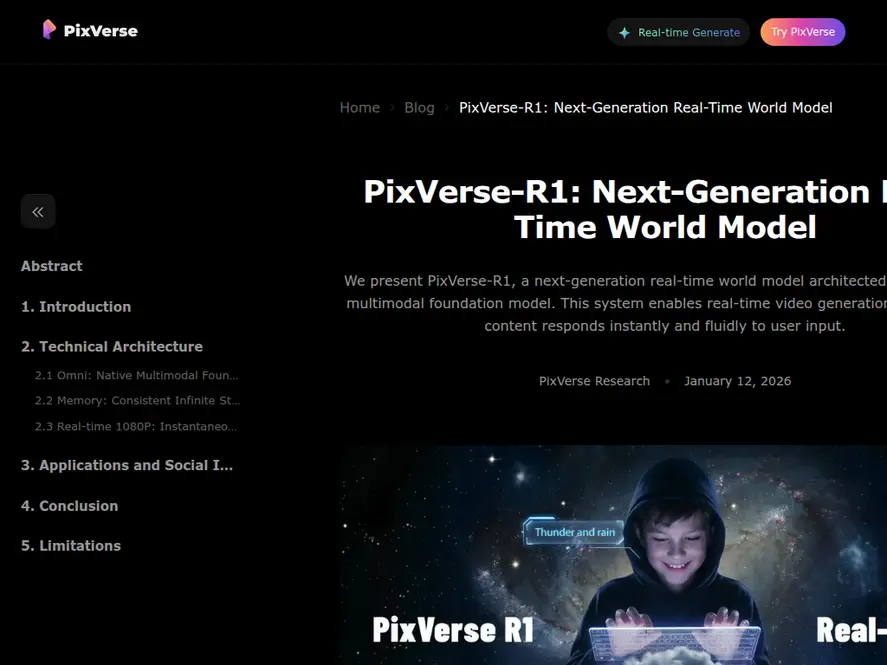
PixVerse-R1: The Real-Time World Model Transforming AI Video
A new architecture shifts generative video from static clips to infinite, interactive streams, enabling real-time 1080P simulation for developers and creators.
The landscape of generative media is undergoing a critical transition. For years, the standard pipeline for AI video has been static and high-latency: input a prompt, wait for rendering, and receive a fixed-length clip. PixVerse has just dismantled this workflow with the introduction of PixVerse-R1, a next-generation real-time world model designed to generate continuous, high-fidelity video streams that respond instantly to user input.
For builders and founders in the AI space, R1 represents more than just faster video generation. It signals the arrival of true AI-native interactivity, capable of powering everything from dynamic gaming environments to immersive simulations. This shift distinguishes it from traditional generative video platforms such as Runway, which primarily focus on static clip production.
The Architecture: Omni, Memory, and Speed
PixVerse-R1 is not merely an optimization of existing diffusion models; it is a re-architected system built on three distinct pillars designed to handle the complexity of real-time world modeling.
1. The Omni Native Multimodal Foundation
At the core lies the Omni-model, a native multimodal foundation that unifies text, image, audio, and video into a single processing framework. Unlike traditional pipelines that stitch together different models (creating "silos" where data is lost or misinterpreted), Omni processes these modalities jointly.
- Unified Tokens: It treats all inputs as a continuous stream of tokens, allowing for arbitrary multimodal inputs.
- End-to-End Training: The model is trained across heterogeneous tasks simultaneously, preventing error propagation between separate stages.
- Native Resolution: By training on native resolutions, the system avoids the artifacts common in cropping or resizing workflows.
2. Autoregressive Infinite Streaming
Standard diffusion models often struggle with consistency over long clips. PixVerse-R1 solves this using an autoregressive mechanism. Instead of generating a bounded clip, it predicts frames sequentially, theoretically allowing for infinite video generation.
To prevent the "hallucination drift" common in long AI videos, R1 utilizes a memory-augmented attention mechanism. This allows the model to retain context from previous frames, ensuring that objects, characters, and environments remain physically consistent over long horizons.
3. The Instantaneous Response Engine (IRE)
Perhaps the most significant breakthrough for developers is the Instantaneous Response Engine (IRE). High-quality video generation typically requires dense computational power, making real-time applications impossible. However, with developments targeting lower inference costs emerging across the hardware landscape, the path to economical real-time generation is becoming clearer.
The IRE achieves real-time 1080P generation by optimizing the sampling process:
- Drastic Step Reduction: Using "Temporal Trajectory Folding," the model predicts clean data distributions directly, reducing sampling steps from dozens down to just 1–4.
- Guidance Rectification: It bypasses the heavy overhead of Classifier-Free Guidance by merging conditional gradients directly into the student model.
- Adaptive Sparse Attention: This reduces the computational load by mitigating redundant long-range dependencies.
Implications for Builders and Developers
The shift to real-time, stateful video generation opens new frontiers for application development. PixVerse-R1 moves generative AI from a "creation tool" to a "runtime engine."
- AI-Native Gaming: Developers can create games where the environment evolves dynamically based on player actions, rather than relying on pre-rendered assets.
- Interactive Simulation: From industrial training to architectural visualization, the ability to steer a high-fidelity video stream in real-time allows for rapid scenario exploration.
- Human-AI Co-Creation: The low latency bridges the gap between intent and result, allowing creators to "direct" scenes live rather than iterating through slow render queues.
Current Limitations
While R1 pushes the boundaries of performance, it is not without constraints. The trade-off for real-time speed involves a delicate balance with physical fidelity. The PixVerse team notes that to achieve instant response times, some generation complexity was sacrificed. Consequently, the rendering of complex physical laws may not yet match the precision of slower, non-real-time models that prioritize fidelity over speed.
Additionally, while the memory mechanism mitigates drift, temporal error accumulation remains a challenge. Over highly extended sequences, minor prediction errors can still compound, potentially affecting the structural integrity of the simulation.
Conclusion
PixVerse-R1 marks a definitive step toward general-purpose world simulators. By combining multimodal understanding with an ultra-fast response engine, it provides the computational substrate necessary for the next generation of interactive media. For the developer community, the focus now shifts from how to generate a video, to how to build persistent, evolving worlds. This positions it alongside other advanced world models like Sora 2 in pushing the boundaries of what AI-generated environments can achieve.
Discover more cutting-edge AI tools and applications on Appse, your comprehensive directory for the latest innovations in artificial intelligence and video generation technology.